No Results Found
The page you requested could not be found. Try refining your search, or use the navigation above to locate the post.


Apart from your own home, which place do you eat most frequently on a daily basis? If you think about it, it is likely to be your office, college or an institution that you visit regularly. In today’s fast-paced environment, a large number of working professionals and students are spending the majority of their time at the workplace or college campus. The long working hours, classes or client meetings and short deadlines are only increasing the time spent at these places with little time left for eating healthy or exercising. Hospitals and call centers have workers who spend entire days and even nights working, often at the cost of their health. When we are at work, we are not always mindful of what we eat or drink, often resorting to unhealthy food, drinking excessive tea or coffee or even skipping meals altogether.
Shri Arun Singhal, CEO, FSSAI
In addition to this, safe and healthy options are often not available at most workplaces, leaving no choice but to rely upon what is available to satisfy one’s hunger. Hence, there is a need to ensure that the food we eat at campuses is safe and healthy, given that diet related diseases such as obesity, diabetes, high blood pressure and heart diseases are rising at an alarming rate.
To address these concerns and support campuses for ensuring availability of safe, healthy and sustainable diets for their employees, students, patients, inmates, etc., the Food Safety and Standards Authority of India (FSSAI) has introduced a nation-wide programme called the ‘Eat Right Campus’ (ERC). This initiative has been launched with two objectives, one is to create an environment of safe and healthy food habits for people in various campuses through compliance to a set of well-defined parameters; and continuously reiterating the message of “mindful eating habits’ through awareness activities within the campus premises for continuous behavioural change.
Under this initiative, benchmarks have been created on four different parameters based on which campuses are evaluated and certified as ‘Eat Right Campus’. These parameters include food safety measures, steps to ensure provision of healthy and environmentally sustainable food and building awareness among individuals in the campus to make the right food choices.
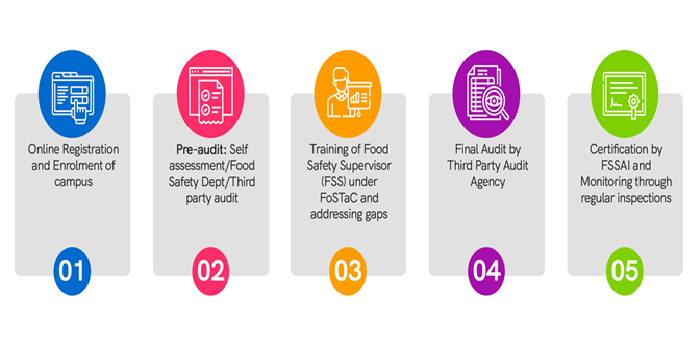
A detailed checklist has been created based on the above four parameters, outlining the best practices to be followed by the food handlers within the campuses. This goes beyond the mandatory requirement of licensing and registration of food service providers within the campuses. The certification is a powerful tool that ensures that food cooked/ handled/ served and stored in the campuses is safe and hygienic. Further, it ensures that food vendors comply with food safety and hygiene standards as per Schedule 4 of the Food Safety and Standards (FSS) Act, 2006. Additionally, the third party audit/ hygiene rating audit of the campus kitchen provides a sense of recognition to the campus, thereby reducing the chances of frequent inspection visits by the food safety department in that area.
Eat Right Campus recognizes the efforts of a campus towards ensuring the health of its people, adds prestige and brand value to its name and inspire others to adopt similar best practices. In particular, it provides a unique opportunity to workplaces to showcase their efforts around employee health and wellbeing. This serves as a key incentive to attract new talent and top performers, thereby boosting high quality recruitment and employee performance. Investing in the health and wellbeing of employees also reduces absenteeism and healthcare costs and ultimately serves to build the reputation of the organization. Many workplaces strive to acquire a high rank in global workplace related ratings/indices. The ERC certification similarly aims to create a sense of competition among campuses across the country towards raising the standards of food safety, nutrition and food sustainability.
With as many as 1346 certified campuses now, this initiative is targeting varied sectors like government organisations, private workplaces, colleges/ universities, tea estates, etc. Recently, a wide range of Government bodies like Anganwadi Centres, Police stations, Jails, Legislative Assembly, Delhi, etc. are covered under the ambit of Eat Right Campus initiative. As this initiative grows to include all campuses in the country, it will contribute to the productivity and economic growth of the country while also safeguarding people’s health.
FSSAI is following a holistic approach by engaging with various institutions of national importance, government colleges, universities, IITs, IIMs, hospitals, and Central government ministries, to enrol them into the programme. Additionally, the Food Authority is working with various industry associations to enrol their member companies under this programme. Similarly, food service establishments like hotels (with a separate staff canteen/ kitchen) are being sensitized to join this initiative and contribute to the productivity and economic growth of our country while also safeguarding people’s health.
The page you requested could not be found. Try refining your search, or use the navigation above to locate the post.

Due to the Covid pandemic and the Russia-Ukraine war, the rate of inflation has increased significantly around the world. India has not been spared by this effect of rising inflation. This is a major reason why recently the Reserve Bank of India increased the repo rate by 0.90 percent. Due to this, the loan rates in the country are seeing a significant increase. A few months back, home loan rates were in the range of 6.40-6.80 per cent. At the same time, after increasing the repo rate by RBI, the loan rates have increased to between 7.30-7.70 percent. In such a situation, when taking a home loan, you will have to pay higher interest rates than before. In this article, we are going to discuss measures by which you can take a home loan to build a house or buy a house at affordable rates.
Subas Tiwari
It is often seen that in case of refinancing, banks offer home loans to the customers at interest rates lower than the advertised rates. However, to get this exemption, you have to meet the eligibility criteria.
If you are paying a very high interest rate on one of your loans, then in this case you can reduce it through refinance. For this, you have to find out about this by visiting your nearest bank.
If you want to take a home loan at low interest rates, then it is very important to have an accurate credit score for this. If the credit score is not correct, you may have to pay a higher interest rate. To improve your credit score, you need to raise your CIBIL score above the score of 750.
Many times banks or loan offering institutions give loans to women at the lowest rates. In such a situation, try to apply for a joint loan with a woman in your family while taking a loan. In this situation, you can get a loan at lower interest rates than before.
Home Loan Balance Transfer allows you to transfer your outstanding loan from other loan institutions to another Banks/NBFCs at a lower interest rate, this helps in reducing your EMI. Home loan balance transfer or refinancing or simple balance transfer is a process by which you can take advantage of lower interest rate offered by other Banks/NBFCs on existing loans.
Taking a home loan makes the process of buying your home easy, but you can also find a home loan that has low interest rates and other value added services. In such a situation, you can transfer your home loan to the lender providing better services. This process of switching or transferring your home loan from one lender to another is called home loan balance transfer.
Usually, you shift your home loan balance to another lender when you feel the rules of your current lender are unfavourable and are not ready to negotiate. However, you can have many reasons for transfer, but the main reason for balance transfer is high interest rate. This may be due to the presence of many other reasons such as stringent rules, a lot of extra charges and poor customer service.
It is best to transfer home loan balance in the initial years of your term. This is because initially the share of interest in each EMI is much higher than the principal. So, this is the time when you can get the most benefit by falling interest rates. Also, remember that for transferring the balance you may have to pay a fee to the new lender and pay the processing fee again. So, keep these numbers in mind, understand your total benefit and decide accordingly. This guarantees that your balance transfer will actually help you in saving.
How does home loan balance transfer benefit you?
Any employed, self-employed professional or self-employed businessman can apply for home loan balance transfer. Although all the lenders have different eligibility conditions, some similar conditions are as follows:
Submit an application to your current lender: When you are ready for balance transfer, it is important to inform your lender through the application. There will be a letter or form in this application. In both cases, prepare your application carefully and describe the reasons for the transfer. If it is a form, make sure that you fill it in correctly.
Take NOC or MoU: After completing the initial formalities, your lender will contact you to give you a Consent Letter or No-Objection Certificate (NOC). This document is very important, because when you give your application, then your new lender will ask you for this document.
Assign Your Document: When you have received the NOC, you can contact your new lender and hand over all your documents to him. Apart from submitting the required documents like NOC and KYC, you may also have to submit a copy of your property document, loan balance statement and interest statement and filled application form.
Get Confirmation from Old Lender: After submitting all your documents to the new lender, wait for the final confirmation from your old lender regarding the closure of your loan account. This proves that the loan contract has expired as per the terms of the loan contract.
Pay the applicable full fees and start afresh: Now, all you have to do is sign the contract with the new lender and pay the outstanding fees. Once this is complete, you can repay the EMI for the next month. This complete guide can help you easily transfer the balance of your home loan to the lender of your choice. After this, you will be able to take benefits like the affordability and flexibility offered by your new lender.
Approval of home loan involves several stages. However, these are completed quickly, after which the loan is disbursed in a few days.
Step 1. Application
The first step is to fill the application form with some details like name, phone number, PIN code, employment type, etc. The Bank / NBFC representative will contact you to further the application process.
Step 2. Assemble the Document
Bank / NBFC representative will come to your house to take the necessary documents for home loan. These documents are
Step 3. Document Processing and Verification
The lender will process and authenticate your document. They can contact your office or related organization to confirm your employment or business. In this phase, they will check your CIBIL score and credit report.
Your loan application will move to the next stage only when all the documents are in order, and your CIBIL score and credit report are satisfactory.
Step 4. Approval Letter
After completing the above steps, you will receive an acceptance letter. The acceptance letter usually includes the following information –
The acceptance letter may also include other terms, conditions and policies of your loan. To accept their offer, you have to sign a copy of this letter and give it to your lender.
Step 5. Payment of security fees
After signing the acceptance letter, you will have to pay a one-time security fee. The lender may ask you to pay this fee in advance.
Step 6. Checking legal and technical information
The lender will check the legal and technical information before disbursing the loan. They will also send their representative to inspect the house.
Step 7. Loan Agreement and Disbursal
You will receive the original agreement letter, after thorough investigation from the lender. Finally, the company will disburse your home loan as per the terms.
When most of us suddenly need money, personal loan is the easiest route. The reason for this is because the banks give loans in a short time. But, there are many cheaper options available in the market as compared to personal loans. For taking a loan at a cheaper interest, you can approach a top-up or gold loan on a home loan. If you have taken a home loan, you can easily talk to the bank and top-up it on that loan. The interest rates of top up loans are slightly higher than home loans but much lower than personal loans.
This mainly allows one to avail a loan amount on a home loan. Banks offer this loan to customers already taking home loans, given their financial standing. However, top-up facility can be availed only after 6 to 12 months of taking home loan.
Top-up loans can be used for any purpose. If you renovate the house, you will also get the benefit of income tax. Top-up loans can also be used for children’s education, daughter’s wedding or for purchasing additional properties. This loan is taken in addition to the existing home loan, so along with the payment of the home loan, the monthly instalments of the top up loan have to be paid.
Banks generally offer 65 to 70 percent of the property’s current value (including home loans) as top-up loans. For this, the banks get the property appraised. The maximum amount of a top-up loan depends on the individual lenders. The more the home loan is paid, the more top-up loan you get.
It is available at a low rate of interest: This loan is available at a low rate of interest, due to which it is economical and it is easy and easy to pay. You can avail a higher amount with a small adjustment in your EMI.
It has a longer tenure: On a top-up loan, you can enjoy the same long-term convenience as a home loan. This reduces the value of EMI, making it easier to repay further.
It provides quick money: The eligibility criteria for this loan is normal and its disbursal is also easy to process. This ensures that you can apply to get the money whenever you need it.
It does not require a separate application: When you take a top-up loan, you need a separate loan from the beginning. No need to apply for it. This application process is simple and fast.
It provides tax benefits: Interest paid on top-up loans is tax free under Section 24 of the Income Tax Act. To take advantage of this, you have to prove that the top up loan will be used to buy, build, improve or renovate the residential property. If you use the loan amount for the education of your children, you can still avail this rebate.
Complete loan eligibility: When you take this loan, you also get an offer for home loan balance transfer. Generally, lenders review your previous payment history and total home loan amount before accepting your previous payment history. The amount of top-up loan also depends case by case. If the value of your property is high, then Banks/NBFCs gives top-up loan which is more than the amount of your home loan.
Fill the application form: To apply for this loan, you can choose between online and offline medium. It is easy to apply online and you have to submit a basic form which you can fill in minutes. However, it is important to enter your details correctly for easy processing.
You may have to submit a copy of the original KYC document and your property paper. Before applying, you should get the information about the documents required for the home loan, which you will have to submit as soon as possible so that the approval for the loan can be obtained quickly. After this, Banks/NBFCs will review your application and will disburse the amount directly in your account. With this information, you can easily apply for a top-up loan and make full use of it.
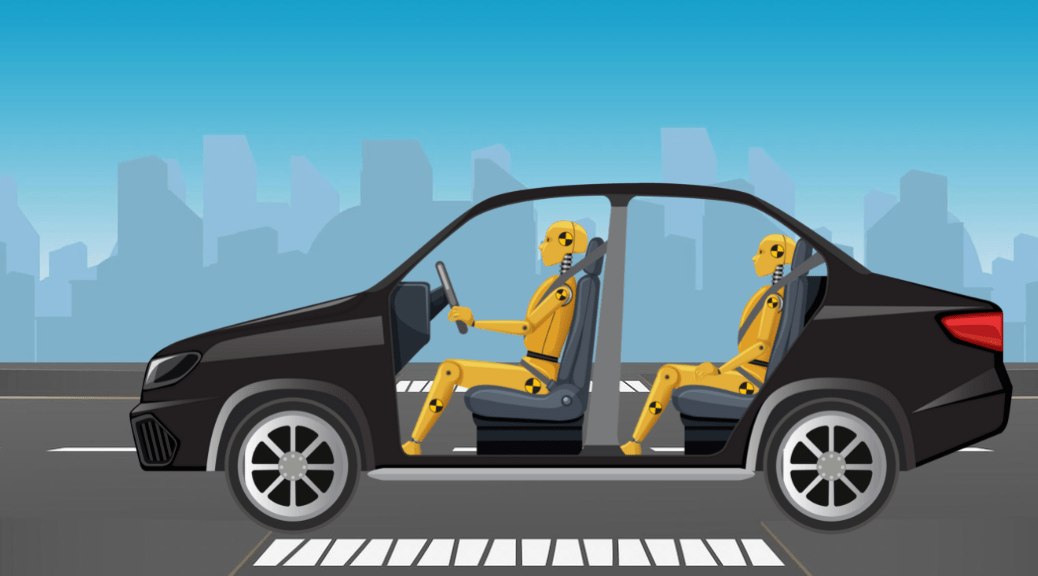
The tragic and sudden death of business tycoon Cyrus Mistry has shocked the nation. Billionaire business tycoon Cyrus Mistry, former chairman of Tata Sons and a scion of the Shapoorji Pallonji Group, died in a road accident, along with Jehangir Pandole, former director at the London office of KPMG.
The most shocking thing about it was that it was perhaps avoidable. Similar to many other road accidents, if the passengers in the rear seats had been in the practice of wearing seat belts, many lives would have been saved. Preliminary investigations have revealed that Cyrus Mistry was not wearing a seat belt. Mr Mistry was sitting in the back seat along with Mr Pandole.
This safety norm is disregarded by almost every Indian. Partly due to legal requirements, front seat passengers have now gotten into the habit of fastening seat belts, but those sitting in rear seats assume they are safe from injuries and neglect putting on seat belts.
As per Indian law, there must be seat belts for all car passengers and dual airbags for front seat travellers. In addition, luxury cars should also have rear airbags. Mistry’s car had all these standards. However, as per police investigators, he was not wearing a seat belt and thus, may have crashed against the front seat before the airbag set up. If he would have been wearing a seat belt, it could have slowed down the speedy and fatal forward momentum. A rear seat belt acts as a check against an abrupt and fierce force and can be useful even in the cars that lack rear airbags. It is also evident that wearing rear seat belts also reduces the risk for front passengers.
If we look at the road and highways ministry’s road accidents report for 2020, it revealed that 15,100 drivers and passengers were killed due to non-use of seat belts. This is a chilling indicator of how many people have lost their lives because of non-compliance with a basic safety feature.
In India, however, wearing seat belts is a legal compulsion. It is mandatory for a passenger sitting on the rear seat to wear a seat belt as per Central Motor Vehicle Rules (CMVR). Notified in 2004, rule 138 (3) of CMVR makes wearing seat belts compulsory for passengers seated in the front seat or front facing rear seats in a running vehicle. There is also a fine of ₹ 1,000 for those violating the seat belt rule.
A few months back, the Ministry of Road Transport and Highways had proposed that all the front-facing seats, including the rear-middle seat, must have a three point shaped seat belt. It had been chosen because in case of an accident, it protects the chest from sudden front movement and prevents any fatal injuries.
Nevertheless, even though the rules exist, there is inadequate focus on implementing these rules. The WHO reports show that usage of rear seat belts not only prevents fatality of rear passenger by about 25%, but also averts excess injury or death of the front seat passenger caused due to upward throwing of rear passenger.
In addition to strict implementation of laws, awareness programs to increase the usage of seat belts can help in reducing casualty in road accidents. There is also the need to keep a check on speeding vehicles to prevent any untoward accidents. Road safety experts have also stressed that the consistent design of roads would be another valuable factor in preventing such unnecessary mishaps.
In this matter, Union transport minister Shri Nitin Gadkari pointed out the need to follow rules, especially the seat-belt regulations and stated that road safety was the “highest agenda” for the country. He stressed that Mistry’s accident was a new lesson in how road safety was viewed, where belt regulations in the rear seat were not being followed as per the law. He further added that while a law already existed mandating the wearing of seat belts in the back now a fine will be introduced to enforce the rule more stringently. The minister assured that intention behind the penalisation is to raise awareness that people should respect and fear the law to save lives. The Centre is also planning to make it mandatory for automakers to introduce a seat-belt alarm system for rear seats and to provide six airbags inside cars.
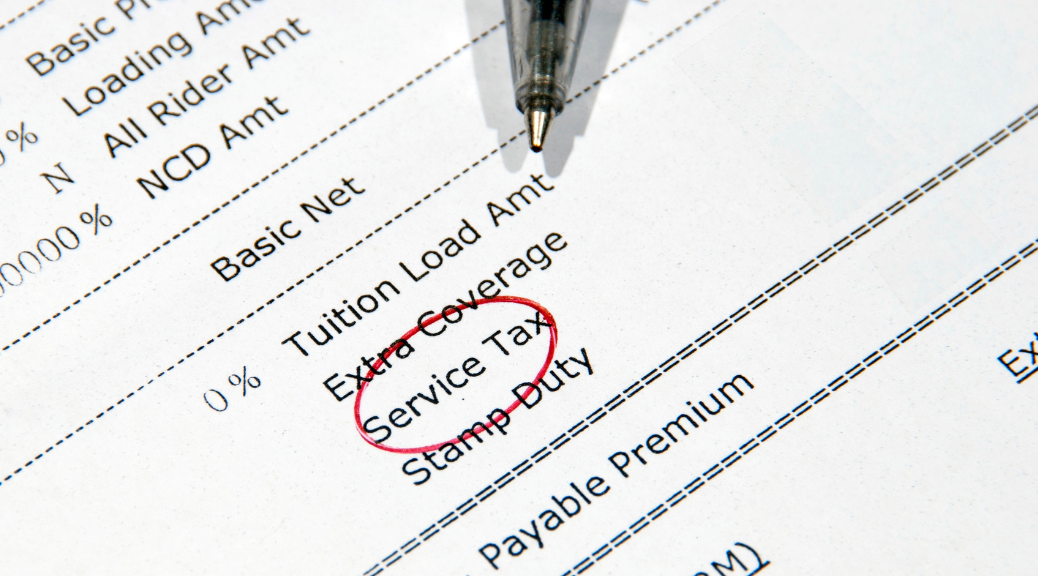
The Notification by the Ministry of Consumer affairs issued on 04.07.2022 in the form of Guidelines are meant to stop levy of service charge by the Hotels and restaurants in the bill while customer avails service by visiting at their premises.
The question arises here as to whether guidelines in this form are really of any help to consumers and serve any purpose? We need to go back to the similar Guidelines issued in the year 2017 also on 21st April when CCPA was not formed and guidelines were issued by Ministry under the signature of Dy Secretary to the Government of India. This time CCPA under its power under section 18(2) of the Consumer Protection Act 2019 has done the same act with the similar guidelines.
In the earlier Guidelines of 21.04.2017 observations by Ministry was as hereunder-
The above Guidelines were found absurd by many consumer luminaries and were criticised for the reason service charges were made optional /voluntary. It is not clear from the language whether it is voluntary to put in bill or voluntary to pay by the customer .But Hotels / restaurants are guided to keep column blank meaning thereby column can be very much there
Now coming to the new guidelines the same observations are made that Hotels /Restaurants are levying service charge in the bill by default without informing consumers that paying such charge is voluntary and optional.
Further Ministry again talks of Tips system like earlier guidelines and assumes that service charge is levied in substitute to Tip to waiter for good services
Further Ministry holds that service charges shall not be collected by adding it along with the goods bill while levying GST on the total bill
Further emphasis given that aforesaid guidelines shall be in addition to and not in derogation of the guidelines dated 21.04.2017
Legal repercussion of the above can never be any redressal from the court of law if at all consumer prefers so. First, it is guideline with less legal force and above that option to levy or pay service charge is not clear whether this option is to the htel /restaurant or to the customer . Most of the consumers do not know they have option to refuse and if some refuse, they can be obliged by not taking such charge and matter ends
It’s just no relief .One fails to understand why any option again when GST system is now prevailing as one time tax for everything.
Further any legal manual should be very specific, clear in terms of implementation and should not be narrative which could lead to more than one meanings. In both the above guidelines there is unnecessary presumption of tip by way of service charge when issue is limited –levy of Service charge . It is also mentioned in both the guidelines that some hotels restricted the entry if customer is unwilling to pay service charge which sounds untrue. How can an hotelier know that this particular person entering will not pay service charge at the end when bill is given? Such narrations cannot be the part of manual like document.
Further in both the guidelines one thing is commonly said that there is no restriction on cost of food items, hence service charge not desired but at the end it is said optional /voluntary.
Here it is very relevant to quote the views of SC from its judgments in the matter of the Federation of Hotels and Restaurants Association of India & Ors Versus Union of India & Ors. Again in the year 2009 in the matter of Delhi Gymkhana Club Ltd V Union of India elaborating the scheme and law in detail. The question raised in the year 2007 in the case of Federation Of Hotels & Restaurants Association Of India & Ors V/S Union Of India was as to whether it is permissible for the hotel to charge their customers any price above the maximum retail price mentioned on the mineral water bottle .The court held in clear terms that charging price for mineral water in excess of the MRP printed on the packaging ,in the provision of service to the customers does not violate any of the provisions of the standards of weights and measurement act as it does not constitutes a sale or transfer of the commodity to them Billing by hotelier/restaurant for service and goods is one and indivisible. It is further elaborated that a customer when enters a hotel or restaurant ,it is not simply to make a purchase of these commodities .His direct purpose of going therein is more than this-it is to enjoy its ambience ,hence held NO for courts to interdict the sale of bottled mineral water.
The most important part of the above judgments is that Billing by hotelier/restaurant for service and goods is one and indivisible. Henec there is no question of optional service charge ,this is the law explained by Supreme court as back as in 2009
Hence Guidelines are absurd, not specific and difficult to implement
By Dr Prem Lata
Ex –Member, Consumer Commission
(1)
It is well settled law that –
“Requirement of leading detailed evidence could not be a ground to shut the doors of any forum created under the Act like the Consumer Protection Act.”
CCI Chambers Coop. Hsg. Society Ltd. vs. Development Credit Bank Ltd.
(2003) 7 SCC 233
(2)
“We find that the approach of the NCDRC is erroneous as If the NCDRC is of the opinion that the Surveyor was an unnecessary party or the pleadings are contradictory, it should have struck down the said party. The striking of surveyor from the array of parties would not make the complaint disjoined, as it was duty of the NCDRC to strike of an unnecessary party.”
Said Supreme Court
“As a part of principles of natural justice, if there are allegations against the Surveyor and the loss assessor, an opportunity should have been given to such person to rebut the allegations.”
Bharmaputra Biochem Private Limited Versus New India Assurance Company & Anr SC
Civil Appeal No. 6943 Of 2021
February 21, 2022