No Results Found
The page you requested could not be found. Try refining your search, or use the navigation above to locate the post.

To ensure availability of safe and hygienic food to consumers, effective food testing measures are vital at every necessary step throughout the food value chain. The objective of food testing is to ensure that the food is free from the below mentioned hazards:
Food Safety and Standards Authority of India (FSSAI), an apex food regulator, has been continuously working towards improving the food testing ecosystem in the country. Two well established and fully equipped laboratories are supported by FSSAI in Delhi-NCR and Kolkata. They have a significant number of State Food Laboratories as well as NABL accredited private labs with a network of almost 190 notified food testing laboratories.
For improving the food testing infrastructure in the country, FSSAI is implementing a Central Sector Scheme for “Strengthening of the Food Testing Ecosystem” in the Country with a total outlay of Rs. 481.95 Cr that includes provisioning of modern testing equipment in State Food Laboratories across the country as well as allocating Mobile Food Testing Labs and other related measures. To ensure quality and consistency of results from participating food laboratories, FSSAI has recognised food labs as per ISO 17025/2017 only through NABL under integrated assessment system. These labs are being monitored by NABL through audits, verification and other periodical desktop surveillance audit, reassessment and renewal of accreditation.
Food testing is an important part of the food safety ecosystem. It helps in determining any risk that is associated with the food products and builds confidence in consumers that the food available for consumption is safe and hygienic. FSSAI aims to keep the confidence of consumers intact and continues to build a more robust food safety ecosystem in the country to ensure effective food safety as well as credible food testing measures at every level.
The page you requested could not be found. Try refining your search, or use the navigation above to locate the post.

These days, vegan meats are readily available in restaurants, supermarkets, and grocery websites of different brands. Some commonly used foods to prepare these mock meats are peas, jackfruit, soy, quinoa, mushrooms, rice, moong bean, pulses, potatoes, etc. Many of these have a good protein content, specifically soy that has high biological value protein. Flavour plays a vital role in the acceptability of vegan meat. Leghemoglobin extracted from plants makes imparts this flavor to the vegan meat. There is a common notion amongst manufacturers that people prefer meat products over vegan meats as they are better in taste. Studies suggest that consumers found vegan and non-vegan burgers similar in taste, texture and appearance.

The page you requested could not be found. Try refining your search, or use the navigation above to locate the post.


Sunil Kr. Maity had a saving account number in a bank since January 2000. Later the account number was changed on 24.02.2010. The complainant went to deposit a sum of Rs.500 in the bank on 15.09.2012, when the bank staff informed him that the account number had again been changed and wrote a different account number on his passbook. Sunil Maity then deposited Rs. 500 in the account given. On 16.01.2013, the complainant deposited a cheque for Rs.3, 00,000 drawn on SBI but later on 11.12.2013 found balance of Rs. 59 only. On enquiry, the bank informed the complainant that there was another customer by the name of Sunil Maity whose account number was wrongly given to the complainant. The said Sunil Maity had withdrawn the sum of Rs. 1, 00,000 and Rs. 2, 00,000 respectively from that account number.
The Consumer Forum made order in favour of complainant. The State Consumer Disputes Redressal Commission (SCDRC) in appeal upheld the order of the Consumer Forum except to the extent of fine imposed. A revision petition was filed before NCDRC by the Bank.
NCDRC grossly erred in observing that the complainant would be at liberty to seek remedy in the competent Civil Court and filing application under Section 5 of the Limitation Act, 1963. Disagreeing with this approach, the bench restored the order passed by the State Commission.
Various earlier judgments on the issue are relevant to understand the difference between the APPEAL and REVISION before choosing the remedy for redressal of grievance.
It has made two things clear.
Supreme Court in the above referred case of Sunil Kumar Maity has confirmed its earlier stand explaining once again that Revisionary jurisdiction carves limitation of the commission to act within the provisions without going beyond it. This judgment is a milestone in the consumer jurisprudence keeping in view the same provision under the new act 2019 under section 58(1)9b as reproduced above.
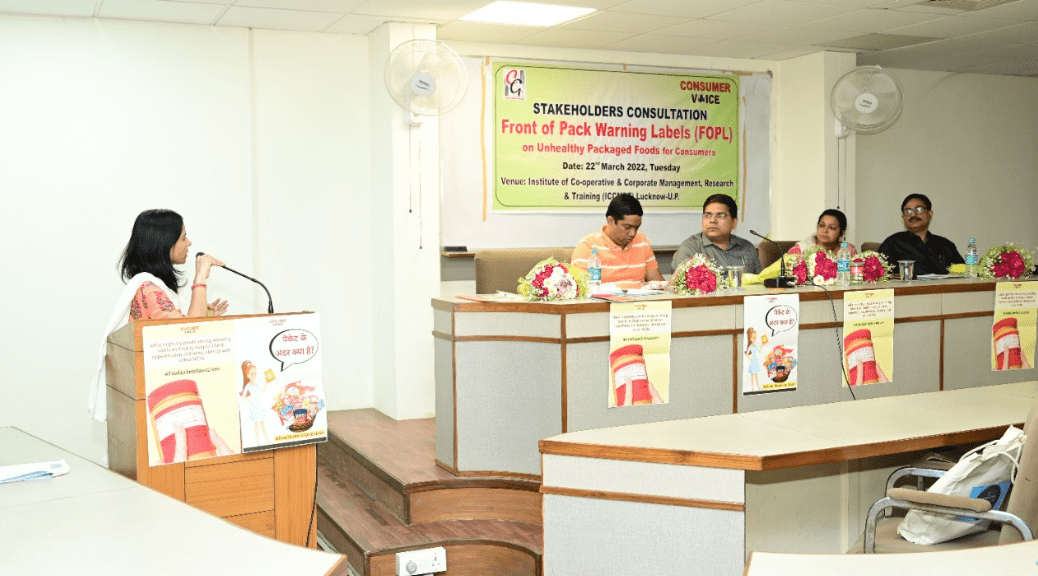

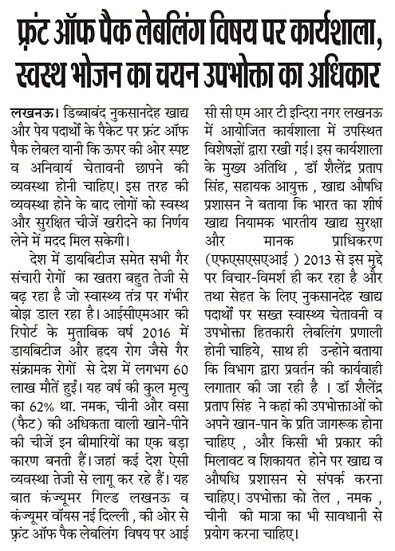
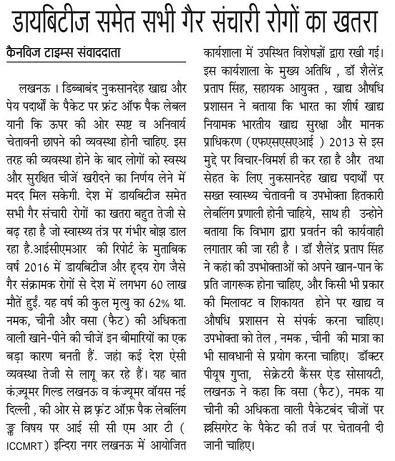
The stage was set with government officials, health and nutrition professionals and consumers, youth, and parents. The session was inaugurated by Shri Abhishek Srivastava, Chairman of Consumer Guild.
It was then taken over by Ms. Ekta Purohit, Manager, Projects, Consumer VOICE, who elaborated on Front of Pack Labels and its importance said that “Amidst the rising concerns over obesity and other non-communicable diseases (NCD) ailments in our country, it becomes imperative for consumers to be a stakeholder in deciding what to eat and what is to be avoided. Front-of-Pack warning labeling represents a key component of a comprehensive strategy to promote healthier lives. It enables consumers to identify in a quick, clear and effective way, products high in salt, sugar and fats.”

Dr Piyush Gupta, Secretary and CEO of Cancer Aid Society while talking about the harmful effects of packaged foods that are rich in salt, sugar and fats said that they too should have warning labels just like cigarette packets that will help consumers distinguish between healthy and unhealthy food products.
Abhishek Srivasta of Consumer Guild said that, “We can improve the situation by letting the consumers make the right choice with a simple warning label on the front of food packets for unhealthy foods. A front of pack warning label on packaged foods will help consumers identify the products that are high in salt, sugar and fat. FSSAI needs to accept WHO advisory standards set for India for limiting the Nutritional Profiles. Also, in FOPL they have proposed HSR label design which star ratings formula which consumers can never understand. As consumer organization, working at the grass root level we need to emphasize that a simple Warning Label symbol is always better for consumer understanding.”

Dr. Shalini Srivastava, Senior Dietician at King George’s Medical University, Lucknow, described the FOPL system as necessary to reduce non-communicable diseases. He said that this step will help in averting the menace of non-communicable diseases like diabetes, heart disease and various cancers. These are diseases that are caused especially by the consumption of highly processed packaged foods high in salt, sugar and fat. Warning labels will help people to make healthier choices and even reduce their consumption of these unhealthy foods.
Kolkata | Rajkot | Chandigarh | Shimla | Bhopal | Guwahati | Lucknow