No Results Found
The page you requested could not be found. Try refining your search, or use the navigation above to locate the post.


Sometimes in times of emergency, we need money immediately. In such a time, instead of selling your investment, taking a loan against securities is a better option. Although the process of loan against securities is a bit slow, but still through this you can take a loan at affordable interest rates. Any type of securities can be pledged to raise funds, such as shares, equity or debt mutual funds, insurance policies and bonds. It is very useful in times when there is an urgent need of cash for any personal or business related needs. Loan against Securities (LAS) is a very popular method for short and long term loans.
Subas Tiwari
Before taking a loan through this, you should check whether the lenders accept the securities held by you or not. Most lenders usually have a list of securities on their website. They are ready to accept only securities on this list. Also, in the case of equities, a lender can give 50 or 60 per cent of the value of the securities as debt, although it can be higher in the case of debt funds or bonds. Some lenders also ask for additional securities in case the value of the securities falls during the loan tenure.
Loan against property helps you to avail timely finance instead of selling off the securities in a haste. The limit of the financial assistance depends on the security that you have pledged. Usually a current account is opened in the borrower’s name and the rate of interest is calculated on the amount that is withdrawn by you during the period of utilisation.
When you pledge a security, you get steady cash easily at the time you need it the most and this also means that you won’t have to sell your shares and not benefit from the bonus and dividends.
Given below are some of the eligibility criteria you will be required to fulfil in order to be eligible to avail loan against securities from a bank:
|
Loan against Securities offered by different banks HDFC Bank Loan against Securities Benefits and features of availing HDFC Bank Loan against Securities: § Minimum loan starting at Rs.50,000 § Easy repayment process § Transparent processing of loan § Interest rate charged on the loan amount used § Penal charges: A penal charge of 18% p.a. plus tax will be levied on the amount drawn in the excess of the limit applicable. ICICI Bank Loan against Securities Benefits and features of availing ICICI Bank Loan against Securities: § Loan based on the value of your securities § Easy withdrawal § Loan interest will be charged on the amount used by you § Penal charges: A penal charge of 6% plus other applicable rates will be levied on the amount drawn in the excess of the limit applicable. TATA Capital Loan against Securities Benefits and features of using TATA Capital Loan against Securities: § Overdraft facility available § Zero foreclosure charges § Quick processing of application form § Security swap facility available § Penal charges: A penal charge of 3% plus outstanding amount per month + GST will be levied on the amount drawn in the excess of the limit applicable. SBI Loan against Securities Benefits and features of availing SBI Loan against Securities: § Loan amount starting at as low as Rs.20,000 and goes up to Rs.5 crore § Available in 5 different schemes § Relationship manager available 24×7 § Easy documentation § No part payment or foreclosure charges § No processing fee for select schemes § Penal charges: A penal charge will be charged at the discretion of the bank and will vary from scheme to scheme. Axis Bank Loan against Securities Benefits and features of availing Axis Bank Loan against Securities: § Loan amount of up to 85% of the value of the securities § Processing fee charged at the rate of 0.15% of the loan amount § Easy documentation § No part payment or foreclosure charges § Penal charges: A penal charge of 2% per month will be charged.
|
Sourced from- https://www.bankbazaar.com
Today, almost every bank in India provides you with the option of availing loan against securities online. The whole process is fast and hassle-free. You can visit the official website of the bank from whom you wish to avail the loan and click on the ‘Apply Now’ button. You will have to enter the details required by the lender and upload the necessary documents. Once the bank has verified the details and documents submitted by you, the loan amount will be disbursed to your bank account.
You can visit the nearest branch of the lender from whom you wish to avail the loan along with the necessary documents. An official from the bank will then further assist you with the process of applying for a loan against securities scheme.
Loan against securities is a loan that a customer can avail by pledging his or her investments in favour of the lender. This loan can be availed without selling your investments.
Loan against securities come as a quick funding respite for contingencies, personal needs and sometimes even for the undefined goals. They are also one of the most convenient and quick forms of loan one can avail at ease.
The applicant can pledge securities of any blood relative who is minimum or above 18 years of age. The person whose securities will be pledged need to be signatory in the agreement and will be considered as a co-applicant towards the loan against securities.
Yes, all the securities that you pledge for loan against securities should be in the demat account. During the application process the account manager can confirm if any mutual fund units or any other physical securities can be accepted in the physical form.
An overdraft account will be set up with customized drawing limits allowing you to utilize the funds as and when required. This drawing limit will be based on the quality and quantity of shares and other securities pledged by you.
Your portfolio will be revaluated on a daily basis as per the market rates. However in case of high volatility and sharp falls in the market, an interim revaluation can also be done. For this, you will be informed by your accounts manager.
Yes. You can pledge more securities for upgrading the drawing limit on your overdraft account. It usually takes up to 2 working days for the upgrade to reflect in your account.
Yes you can apply for a loan against securities as an organisation, HUF or as a non-individual entity. Your business should be a registered business with an existence proof of at least 2 years.
Yes. Loans against securities are legal. The regulations were originally formed by SEBI in May 1997 & last modified in Jan 2018. All market participants in Indian securities market have been permitted to lend/borrow subject to respective regulatory guidelines. All the settlements of loans against securities are guaranteed by the NSE Clearing Ltd.
Related
The page you requested could not be found. Try refining your search, or use the navigation above to locate the post.

Diet sodas are a popular beverage all over the world, among people of all ages who are anxious to reduce their sugar or calorie intake. Instead of sugar, artificial sweeteners, such as aspartame, cyclamates, saccharin, acesulfame-k, or sucralose, are used to sweeten them. There is no doubt that diet soda is a better option for reducing calorie and sugar intake, but that’s not all. There is hardly any other nutritional value in these drinks. Although we do not have many scientific trials to document the long-term health outcome of diet soda, we cannot be mindless in the consumption of these drinks. Consumers are seeking a ‘healthier’ alternative to high-calorie-high-sugar beverages. However, should we straightaway assume that a food or drink that doesn’t contain calories or natural white sugar is ‘healthy’, without a thorough risk assessment? In this article, we share some recent research on artificial sweeteners and their adverse health effects raises multiple questions about regular diet soda consumption.
Richa Pande
Diet soda is composed of water, artificial sweeteners, synthetic colours, preservatives, and flavours. These sodas provide low or zero calories, contain no refined sugar, and zero nutrients to support overall health. Worldwide, millions consume diet soda to avoid weight gain or manage complications of diabetes without having to give up on their favourite soda. It is mindful to know the general composition of something that we consume. Given below are some ingredients commonly present in diet soda drinks:
| Contents of three diet sodas picked from the market | ||
| Ingredients | ||
| 1 | Brand 1 Sugar Free Soda | Carbonated Water, Acids (Citric Acid, Malic Acid), Natural Lemon and Lime Flavouring, Acidity Regulator (Sodium Citrate), Sweeteners (Aspartame, Acesulfame K), Potassium Chloride, Stabiliser (Pectin). |
| 2 | Brand 2 Diet Soda | Carbonated Water, Acidity Regulator (338), Sweeteners (951, 950), Preservative (211), Caffeine. Contains Permitted Natural Colour (150D) And Added Flavours (Natural Flavouring Substances), Contains No Fruit. |
| 3 | Brand 3 Zero Calorie Soda | Carbonated Water, Colour (Caramel E150d), Acids (Phosphoric Acid, Citric Acid), Flavourings (including Caffeine), Sweeteners (Aspartame, Acesulfame K), Acidity Regulator (Sodium Citrate), Preservative (Potassium Sorbate). Contains A Source of Phenylalanine. |
| 4 | Brand 4 Fizz Classic Cola |
Carbonated Water, Sweeteners (Steviol glycosides, Erythritol), Acidity Regulator (330, 331), Vitamin C, Herb Ashwagandha, Salt, Added Permitted Natural Food Colours (150D), Flavours.
|
Phenylketonuria is an inherited disorder that increases the levels of a substance called phenylalanine in the blood. Some diet soda contain aspartame, which is an artificial sweetener composed of two amino acids: aspartic acid and phenylalanine. It thus poses a severe health concern to phenylketonurics, or individuals afflicted with phenylketonuria. Hence Diet Coke using aspartame to provide sweetness while remaining sugar-free, needs to be avoided by phenylketonurics.
It has been found that sugar substitutes such as saccharin, sucralose and stevia can change the composition of the gut microbiota. Some polyols such as maltitol, lactitol, and xylitol, increase the numbers of bifidobacteria in human beings. Intriguingly artificial sweeteners like saccharin & sucralose that are widely used in manufacturing diet soda could impact the gut bacteria- E. coli and E. faecalis. Due to excessive consumption of diet soda that has above ingredients, pathogenic bacteria like E. coli and E. faecalis can adhere to the gut wall, invade the Caco-2 intestinal cell lining, and cause multiple health hazards.
Although diet soda doesn’t contain sugar like regular soda, it’s highly acidic and can take a serious toll on your smile if you drink a lot of it on a regular basis. One study found that both regular soda and diet soda significantly affects the surface roughness of tooth enamel, indicating that both can contribute to tooth erosion.
Diet soda contains several compounds that may negatively affect bone health and lead to bone loss. These compounds include caffeine and phosphoric acid. Caffeine consumption has been reported to decrease bone mineral density, increase the risk of hip fracture, and negatively influence calcium retention.
Some research suggests that the artificial sweeteners found in diet soda may have the same effect on the food reward pathway in the brain as regular sugar, which could lead to increased hunger and food intake. Whether, and how, these phenomena contribute to weight gain is still unclear. Research on this topic is mixed, so additional studies on diet soda and sugar cravings are needed.
Switching from regular soda to diet soda is an easy way to reduce your intake of carbohydrates and calories. However, diet soda doesn’t contain many nutrients, and drinking too much is associated with some short and long-term side effects. For this reason, if you want to drink diet soda, it’s best to enjoy it in moderation. Consider pairing it with a nutritious, well-balanced diet. You can also enjoy plenty of healthier beverage options to help you stay hydrated during summers.
coconut water, cold-pressed juice with no added sugar, freshly prepared lime soda.
The page you requested could not be found. Try refining your search, or use the navigation above to locate the post.
The Supreme Court in the case of Medicos Legal Action Group v Union of India said, “We are of the clear opinion that the contention raised by the learned counsel for the petitioning Trust, of the Hon’ble Minister having made certain statements in course of parliamentary debates on the Bill that preceded the 2019 Act, is of little relevance.” From the pleadings it was found that ‘health care’ was initially included in the definition of the term ‘service’ appearing in the Bill but after extensive debates, the same was deleted. Mere repeal of the 1986 Act by the 2019 Act would not result in exclusion of ‘health care’ services rendered by doctors to patients.
Dr Prem Lata Legal Head VOICE
In the context of the 1986 Act and the 2019 Act, the definition of “service” having been read, understood and interpreted by the Supreme Court in Indian Medical Association (supra) to include services rendered by a medical practitioner to his patient upon acceptance of fees/charges. However, an organization “Medicos Legal Action Group”, had filed a writ petition before the High Court of Bombay as Public Interest Litigation No. 58 Of 2021 and prayed before the court to declare that services performed by healthcare service providers are not included within the purview of the Consumer Protection Act, 2019 and also for mandamus directing all consumer fora within the territorial jurisdiction of this Court not to accept complaints filed under the 2019 Act against healthcare service providers.
Grounds for such an appeal were given as:
On the above points raised by the trust, a detailed discussions were held in the high court and definition of service in both the acts was re-examined to make the things clear. Reading the two definitions, court did not see any material difference between the two. Except inclusion of ‘telecom’ in section 2(42) of the 2019 Act, the terms of the definition were identical.
Section 2(1)(o) of the 1986 Act did not in terms include services rendered by doctors within the term “service”, but such definition was considered by the Supreme Court in its decision in Indian Medical Association Vs. V. P. Shantha & Ors., and it was held-
Court on the basis of definition above examined held that, “Merely because of enactment of the 2019 Act upon repeal of the 1986 Act as well as the parliamentary debates, the efficacy of the law laid down in the decision in Indian Medical Association (supra) as a binding precedent would not stand eroded. This is a thoroughly misconceived Public Interest Litigation and we have no doubt that it deserves outright dismissal”.
Medicos Legal Action Group had approached the Supreme Court through a Special Leave Petition challenging the Bombay High Court’s judgment delivered in October 2021. The Supreme Court on Friday held that doctors and healthcare services are not excluded from the ambit of the Consumer Protection Act 2019.
A bench comprising Justices DY Chandrachud and Hima Kohli affirmed the petitioner based its case on a statement reportedly made by the Union Minister while introducing the Consumer Protection Bill 2018 that health care services are not covered under it. The bench said that the Minister’s statement cannot restrict the ambit of the statute.
Justice DY Chandrachud remarked, “The definition of ‘Service’ is wide enough under the Act. If the Parliament wanted to exclude, they would have said it expressly. The reason why healthcare was deleted was because the definition of the expression of service was wide enough. The Minister’s speech in the house cannot restrict the ambit of the Act while laying emphasis on the word ‘Service of any description’.”
He also added, “We will affirm the judgment of the High Court. It’s a very guarded statement of the Minister also. The Minister is also saying that we have included but not expressly included in it.”
Relevance of Speeches in the Parliament
Supreme Court cited earlier cases wherein parliamentary speeches were in question.
In the case of State of Travancore-Cochin vs. Bombay Co., SC Hon’ble Patanjali Shastri, CJI held, “A speech made in the course of debate on a bill could at best be indicative of the subjective intent of the speaker, but it would not reflect the inarticulate mental process lying behind the majority vote which carried the bill, nor is it reasonable to assume that the minds of all those legislators were in accord.”
Aswini Kumar Ghose vs. Arabinda Bose, ruled, “Speeches made on the floor of the Parliament are not admissible as extrinsic aids to the interpretation of statutory provisions.”
State of West Bengal vs. Union of India, Hon’ble B.P. Sinha, CJI held, “A statute is the expression of the collective intention of the Legislature as a whole and any statement made by an individual, albeit a Minister, of the intention and object of the Act, cannot be used to cut down the generality of the words used in the statute.”
While concluding, the SC in clear terms indicated that the parliamentarians might have thought of not including `health care’ as that would have amounted to a mere surplus.
“If at all the Parliament while repealing and replacing the 1986 Act with the 2019 Act had intended to give a meaning to the term ‘service’ different from the one given by the Supreme Court, such intention ought to have been reflected in clear words by a specific exclusion of ‘health care’ from the purview of the 2019 Act. While construing a statute, what has not been said is equally important as what has been said.”
Related
The page you requested could not be found. Try refining your search, or use the navigation above to locate the post.
Consumer VOICE, organized a sensitization workshop on Importance of Food Labeling at Dayanand Secondary School, Vivek Vihar… Read More
Consumer VOICE organised an interactive workshop with the students on 7th November with the support of our Gujarat State Partner… Read More
In collaboration with Consumer VOICE, New Delhi, a sensitization workshop on food labeling was organized on 1st October… Read More
Consumer VOICE, organised a sensitization workshop on Importance of Food Labeling at Bamanpukur Humayun Kabir Mahavidyala Bamanpukur,West Bengal along with state… Read More
To find the greatest deal, shoppers frequently examine the costs of foods in the grocery store. Read More
India faces equally difficult issues with regard to food, nutrition, and health. About 5.87 million of all fatalities worldwide. Read More
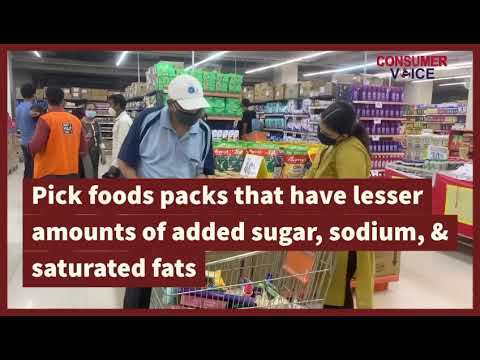
Meera and her mother were shopping. She requested her favourite soft drink and snacks. Her mother, however, suggested that she eat something wholesome. Read More
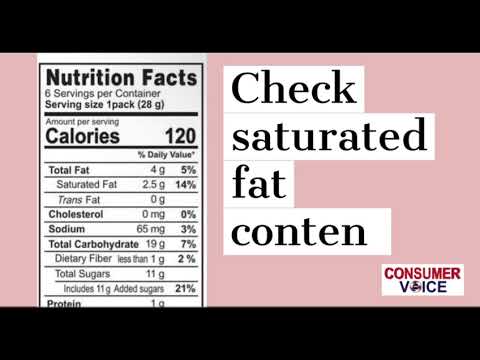
Food label consists of necessary information about the total amount of product contained in a packet, its composition and ingredients. Read More
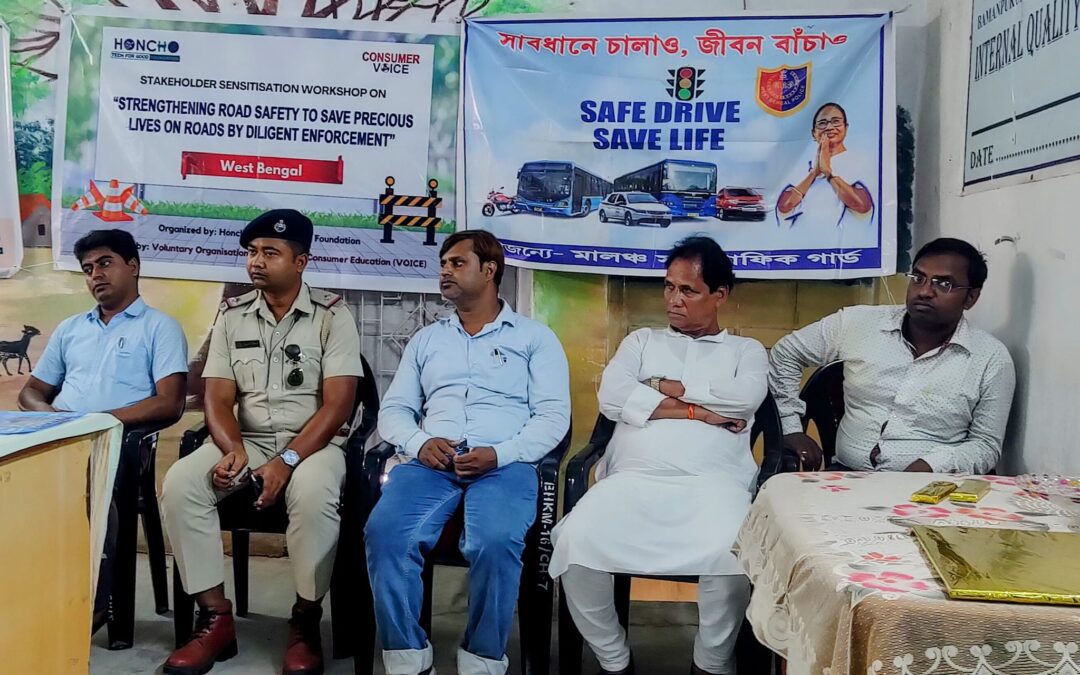
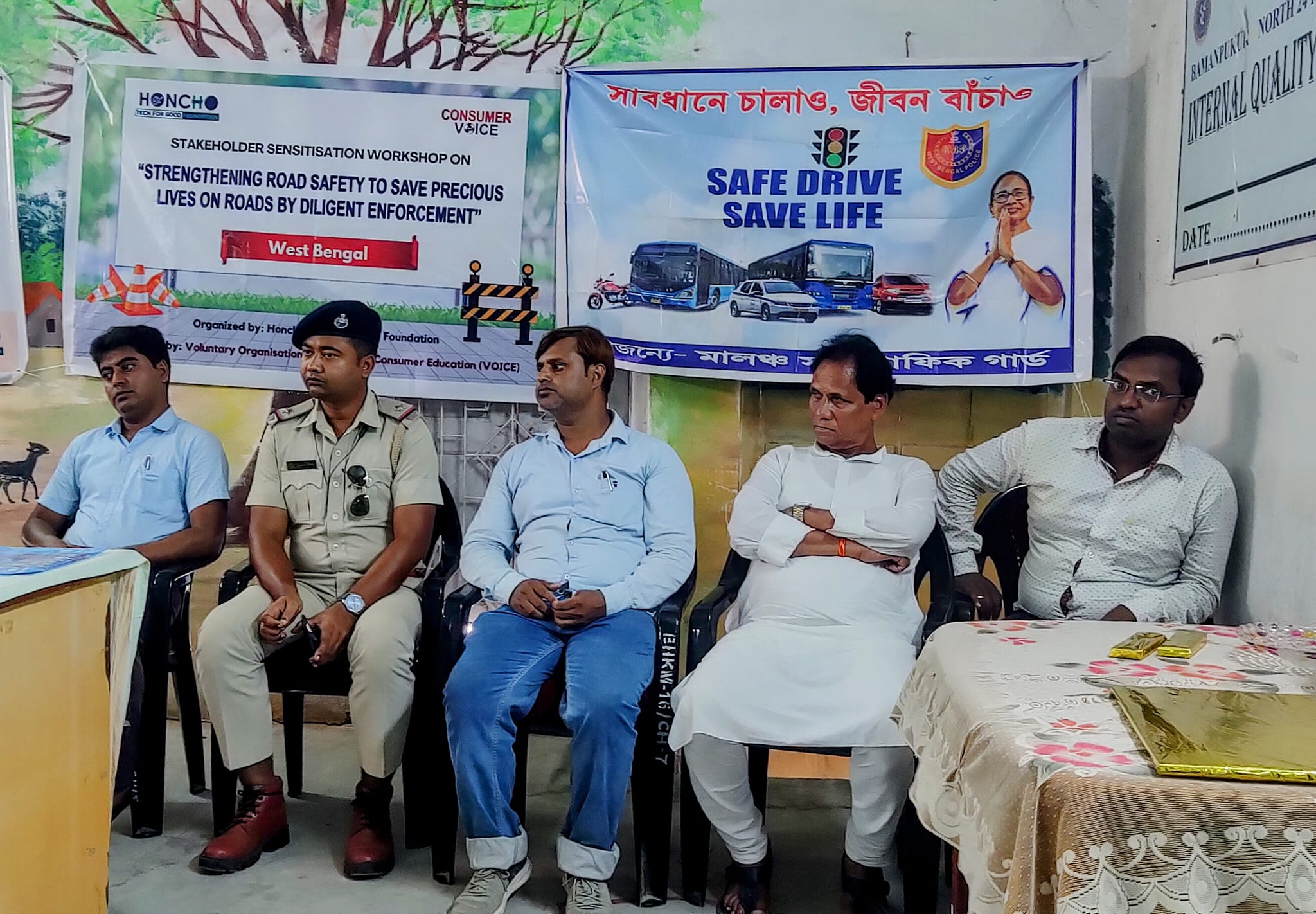
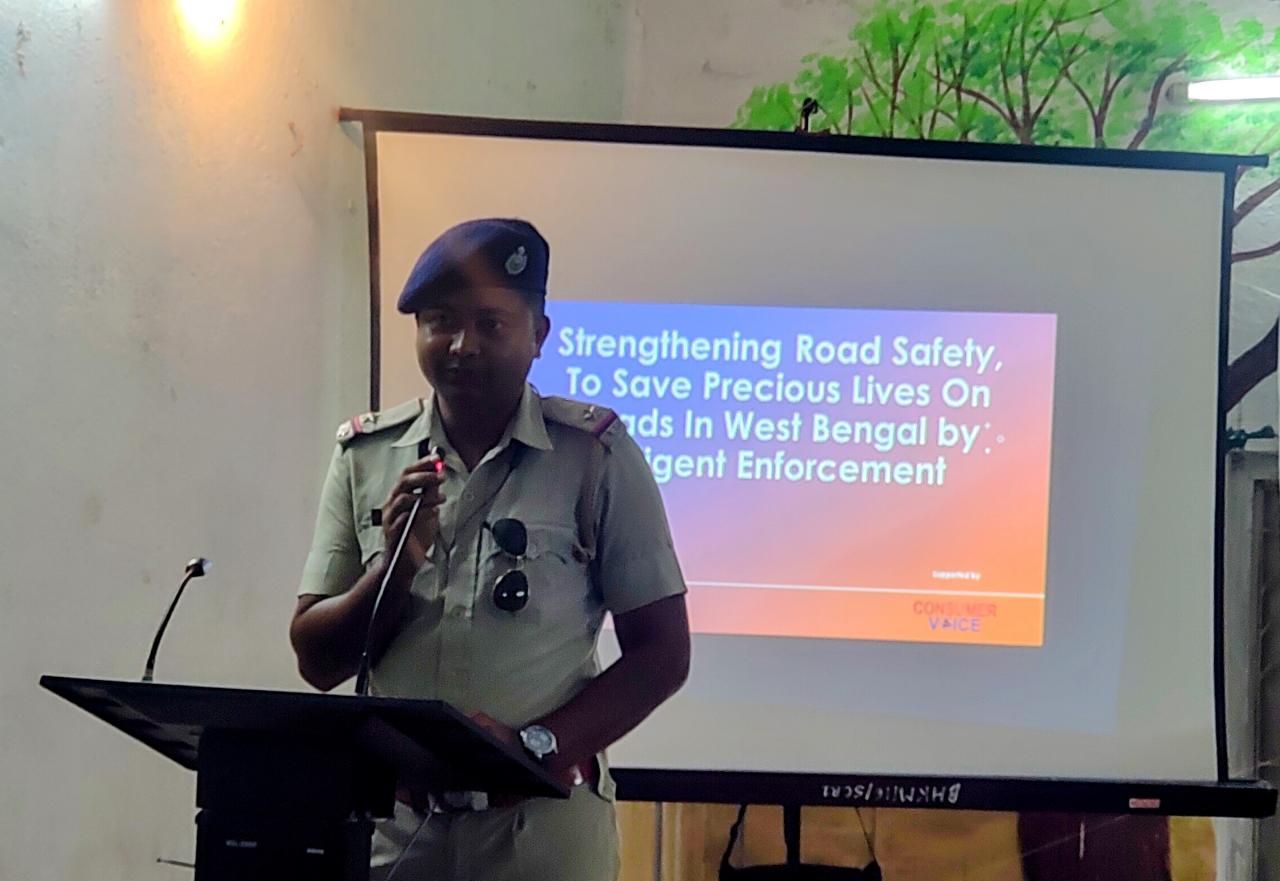
A road safety sensitization workshop was organised by Honcho Tech For Good Foundation, West Bengal with support from Consumer VOICE New Delhi at Humayun Kabir College, Bamanpukur, Minakhan, North 24 Parganas district on 21st June 2022. The purpose of the workshop was to strengthen road safety to save precious lives on roads by diligent enforcement.
The workshop was attended by officials of Basirhat Police District under North 24 Parganas District, Shri Joydeep Paul Traffic Officer Incharge Basirhat Police District, North 24 Parganas represented the ‘Save Drive Save Live Campaign’ Shri Manab Mondal Minakhan Block Coordinator, Shri Raju Paul Minakhan Block President, Hasanujjaman Seikh, PDO (Minakhan Block), Subhas Biswas , Principal and Social Activist of Humayun Kabir Mahavidyalaya and Ms Sayani Das, Celebrity Swimmer youth influencer for Road Safety were also present in the workshop besides President of Panchayat Samiti along with several administrative officers. Shri Gopesh Patra, Deputy and spokesperson of MLA Smt. Usharani Mondal also addressed the audience.
Various aspects of road safety, risk factors linked with MVAA 2019 provisions current situation in the district various measures taken and required to strengthen the road safety were discussed with stakeholders in the workshop. A booklet on road safety highlighting the risk factors and important provisions in the MVAA act was distributed. A presentation was also given by Honcho Tech Officials to elaborate various aspects and an appeal was made to adhere all traffic rules with focus on certified helmet wearing and fasten the strap.