No Results Found
The page you requested could not be found. Try refining your search, or use the navigation above to locate the post.

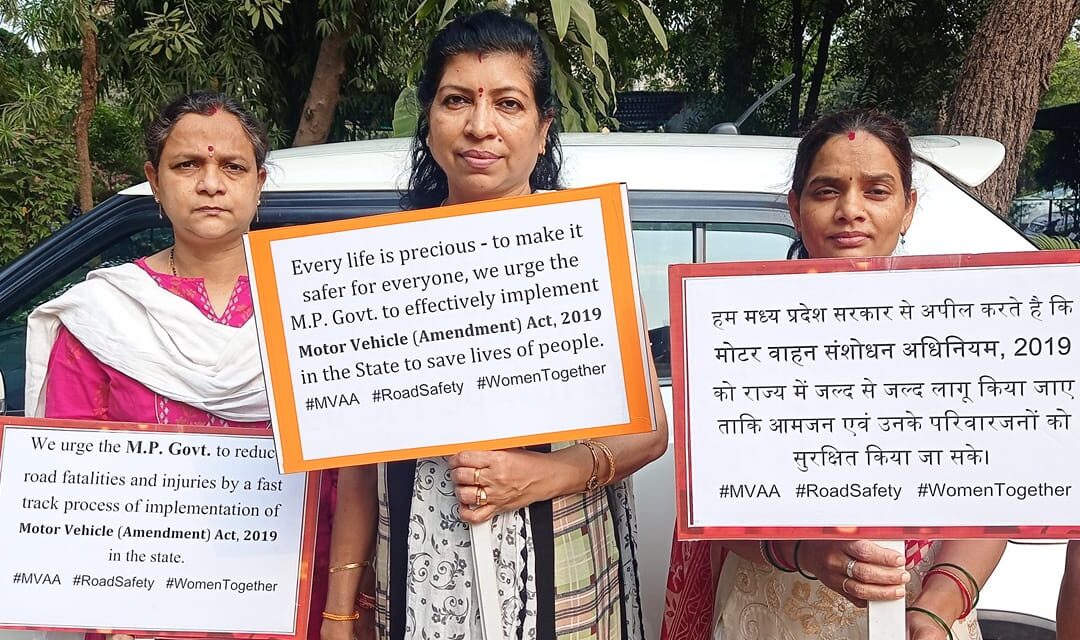
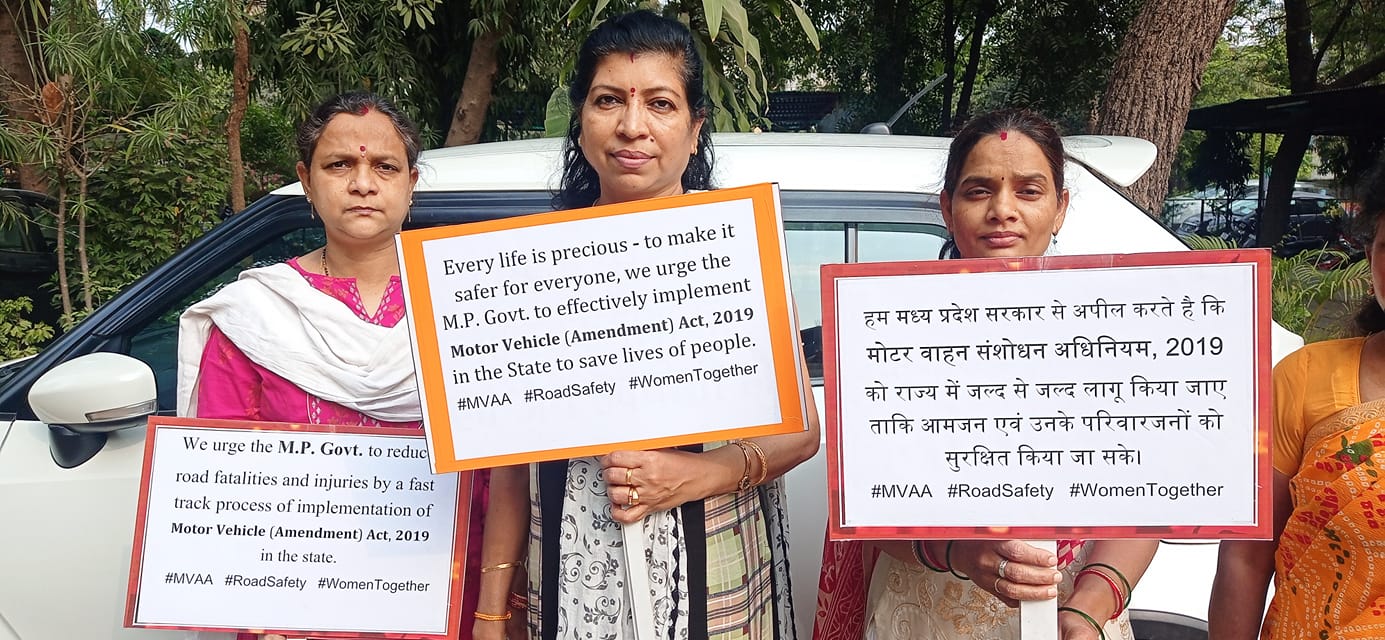
Madhya Pradesh is among the top 5 states that recorded the highest number of accidents and fatalities in 2020.
In the year 2020, 45,266 road accidents took place in the state of Madhya Pradesh as per the MoRTH report on road accidents in India in which 11,141 people were killed. Also as per this report Madhya Pradesh topped amongst the states in terms of number of accidents since 2016.
Recently, 14 people including two children were killed and 17 were injured in different districts of Madhya Pradesh as per the media reports. The Govt. of India is committed in reducing road fatalities by 50% by 2024. The Motor Vehicle Amendment Act 2019 is one of the big steps to reduce road fatalities and strengthen the much awaited road safety legislative framework in India.

The MVA Act 2019 addresses not only key road safety risk factors but also brought much desired improvement in the transport sector, licensing, bringing citizen facilitation, transparency, and reducing corruption with the help of information technology and removing intermediaries. The Act will strengthen public transport, safeguard and protect Good Samaritan and bring in reforms in the insurance and compensation regime.
But unfortunately, the State of Madhya Pradesh has not yet implemented this Act fully, despite being the number 2 state in terms of number of road fatalities. Proper implementation of MVAA 2019 will be crucial for achieving the “Vision Zero” being implemented by the Transport department of MP. We expressed our concerns and approached the Hon’ble Chief Minister and Hon. Transport Minister of Madhya Pradesh in this regard by writing letters and seeking appointments
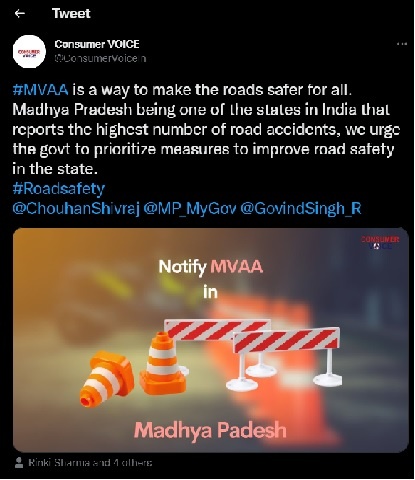
Social Media Support to strengthen road safety in the state of Madhya Pradesh through implementation of MVAA 2019
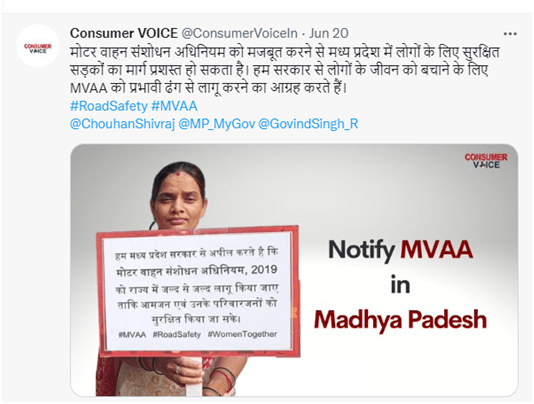
We are continuing our efforts to sensitize policy makers to strengthen Road Safety in the state of Madhya Pradesh by notification of Motor Vehicles Amendment Act 2019 to save precious lives. We are using social media platforms to gather support in this regard by tagging the relevant stakeholders.
https://twitter.com/ConsumerVoiceIn/status/1552208848731389954


As per Ministry of Road Transport and Highways (MoRTH) report, more than 39000 people lost their lives in 2020 as they did not wear helmets. Head injuries are a major cause of death, injury and disability among users of motorized two wheel vehicles.
Riders who do not wear helmets are always at risk of suffering fatal road injuries. A helmet keeps your head safe from injury. Full face helmet also protects your eyes.
If the rider is found wearing a helmet with the straps untied, a fine of Rs 1,000 can be charged. Moreover, if a rider wears a helmet that does not have a Bureau of Indian Standards (BIS) certification or the ISI mark, it will attract a challan of Rs 1,000. Thus, wear a correct helmet properly or be ready to shell up to a fine of Rs 2,000.
Social Media Campaign to sensitise people on the importance of wearing ISI helmets
Head injuries are a major cause of death, injury and disability among users of motorized two wheel vehicles. According to Section 129 of the Motor Vehicles Act, 1998, “Every person, above four years of age, driving or riding a motorcycle of any class or description, shall, while in a public place, wear protective headgear conforming to the standards of Bureau of Indian Standards, and is securely fastened to the head of the wearer using straps or other fastenings provided on the headgear.”
Through our various digital platforms we are sensitizing people regarding the importance of wearing ISI certified quality helmets and also to fasten the strap for their safety not just to avoid penalty.
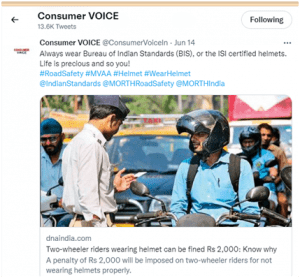


Section 129 of the Motor Vehicles Act, 1998 states that “every person driving or riding a motorcycle of any class or description, shall, while in a public place, wear protective headgear conforming to the standards of Bureau of Indian Standards, and is securely fastened to the head of the wearer using straps or other fastenings provided on the headgear.”
Each genuine protective helmet for two wheelers consists of ISI mark, the helmet’s IS code (IS 4151) above the ISI mark and the manufacturer’s code (CM/L) below the ISI mark. Always buy a helmet with an ISI mark to make sure the product complies to set standards. Never compromise on quality.
Consumer VOICE along with its state partners are spreading awareness on the subject matter to encourage two wheeler riders and pillion riders to wear quality, certified helmets and fasten straps. We are also using our digital platforms for sensitization on the same with support from various organisations, road safety activists, etc.

In a historic decision by the Union Cabinet, an attractive recruitment scheme for Indian youth to serve in the Armed Forces has been introduced with the name AGNEEPATH. The youth selected under the Agneepath scheme will be categorised as Agniveers. With the announcement of this Agneepath Scheme, a great opportunity has been opened for the youths to serve their nation for a period of 4 years.
The Agneepath Scheme recruitment process will allow selected candidates to be enrolled as Agniveers for four years period in the Indian Armed Forces. The Armed Forces will recruit 46,000 Agniveers this year through the Agneepath scheme. On completion of the four-year period, Aginveers will go to the society as a disciplined, dynamic, motivated, and skilled workforce for employment in other sectors to pursue their career in the job of their choice. It’s a fair guess that many of these skilled recruits will get a chance to be absorbed in the forces they serve for another period. This is besides a handsome amount being paid during their farewell which will assist them in their further employment.
The Agneepath recruitment scheme is a transformative enterprise that will provide a youthful profile to the armed forces. In another big change, women will also be inducted into the armed forces under the new scheme. The Army stated that the ‘Agniveers’ would form a distinct rank and a “distinctive insignia” will be worn by the Agniveers on the uniform during their service period. Agniveers will also be offered an opportunity to apply for permanent enrolment in the Armed Forces after a period of 4 years.
There are both supporters and critics of the scheme which has become a potboiler with violence in many states. This needs to be condemned as every government scheme has pluses and negatives. Nothing fits for all and nothing can be a perfect measure to address all issues.
I hope you have loved reading about this topic, which is going to strengthen our youth and country in more ways than one. In the meantime, keep reading the articles we have brought you this month. We have FSSAI CEO’S article on State Food Safety Index 2021-22, a discussion on LAS, choosing the best jam and many more. Do share your thoughts at info@consumer-voice.org.
Until then, happy reading!
Pallabi Boruah
Editor
The page you requested could not be found. Try refining your search, or use the navigation above to locate the post.
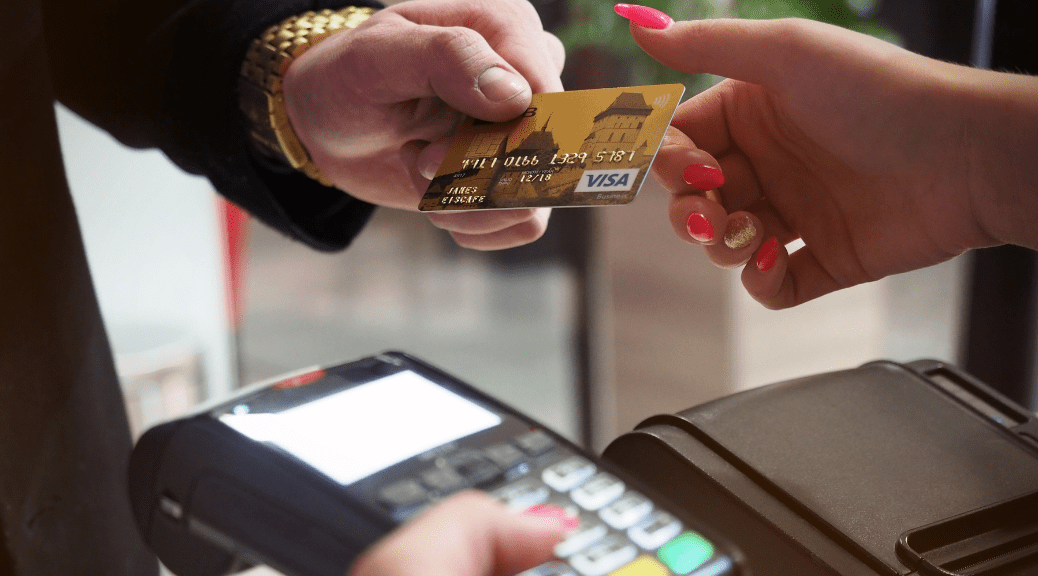
In this era of digital India, credit card is being used a lot. Not only in metro cities, but also in small towns and many rural areas, people use credit cards. However, many things have to be kept in mind while using a credit card. The most important thing in using a credit card is the minimum amount due, which is seen on every credit card statement. Many times people feel that if they pay at least that much money, then the work will go on. Let’s understand the full game of Minimum Amount Due.
Subas Tiwari
If we talk about the minimum amount due written on the credit card, then it is actually a small part of the entire credit card bill. Usually this share is only 5 per cent. Credit card companies write the total bill, minimum amount due and due date on the statement. Many a times people think of paying the minimum amount due and they think that it will not charge them anything.
If a person pays the minimum due account, then he will not have to pay the late payment charge. However, after that your loan can grow rapidly, as daily finance charges are levied on unpaid bills. That is, if your bill is 50 thousand and your minimum amount due is 2500 rupees, then paying only two and a half thousand will not benefit you. Even though you may not be charged late payment, but every day huge interest will be charged on your bill, which will cause you huge loss.
Often, the question arises in the minds of people as to why credit card companies give a lot of reward points on payment of bills. After all, what is the benefit of these companies? How do these companies make money? The game of Minimum Amount Due is also a means of earning of these companies. If you are late for even one day from the due date, then you will be charged huge interest, which can be up to 48 per cent. The problem is that this interest is charged on a daily basis. That is, the longer you delay paying your bill, the more benefit the credit card companies get.
Before you consider any purchase on your credit card, you need to have a detailed strategy on the repayment. It is a great idea to pay off your credit card bill before the due date. Not only does this help in improving your credit score, but it also helps in establishing a good credit profile with the lender. Such profiles are often given better deals on personal loans, discounted financial products, and a host of other benefits.
Most banks also offer you the option of paying back your credit card bills through installments. If you are going through a financial strain, such measures will help you take the load off your head and are a welcome gesture. However, in the long run, these often lead to higher interest payments, thus making it important for you to plan your repayment.
You must be aware of the fact that the odds of a credit card fraud are higher than one with a debit card. That is why it is a great practice to use a credit card only at trusted merchants. It holds in the case of a local store as well as online shopping.
With a host of different credit card options available, it is often seen that the credit card limit of an individual is much higher than their monthly income. It is important to track your monthly spending and use only an amount that you can be confident of repaying. It will save you unnecessary interest compounding, huge debts, and help you establish a financially sound future for yourself and your family.
When you are using a credit card, the core idea is that you are spending money that you do not have yet. It might seem tempting for new users pushing them on the path of overspending. The first step here is to ensure that you do not max out your credit card limit, no matter what the situation.
Ideally, you should restrict your credit card usage to 2/3rd of the limit. For instance, if your credit card limit is ₹3 lakh per month, plan its usage in a way that you do not spend more than ₹2 lakh. It will help you maintain a good credit card score which will be of help at a later stage.
Most banks offer the facility wherein you can set a personal spending limit on the credit card. It is a great option for people who aren’t confident about their shopping habits.
Every credit card is different, and one of the first things that you need to do is understand the billing cycle of your card. As most credit cards have a monthly billing procedure, if you can time your purchase to days immediately after the bill generation, you will have about 45 days of interest-free period for bill payment. Depending on your card, the period may be longer.
The proper usage of a credit card requires one to be disciplined and understand their spending patterns. It is only when you keep a detailed account of all your spend will you be able to identify an unexpected transaction without any time wastage.
When such false transactions are brought to the immediate notice of the bank, most of the time, there is room for rectification. Understand that none of this would be possible if you do not keep track of your transactions on the card.
Almost all credit cards come with a host of benefits and rewards under its loyalty program. From special discounts on e-commerce sites to free movies or flight tickets, there is a range of benefits for credit card owners. To make the most of them, you need to look up the reward program if your credit card issuer and keep yourself updated.
Once you are cautious about your spending habits, the next step is identifying an improper detail associated with the card. The details may range from things like a change in your address or employer to amendments in your marital status. Sometimes, mistakes like fraudulent transactions or accounts may be linked to your card.
Unless you read your annual credit report, you will not know about these things. It is a wise practice to invest your efforts in reading and understanding your credit report. It will help you identify errors as well as plan your credit card expenditure.
While you need to know how to use credit cards and pay its bills on times, sometimes it is inevitable for you to carry forward a balance. In such a situation, you need to be extra cautious and ensure that you are making every monthly payment promptly. Whenever possible, pay off more than the minimum due so that the amount is paid off sooner.
Also, remember that if you have some balance amount on your card, you need to be frugal about the credit card’s usage so that the overall monthly usage is stalled at below 30% of the credit card limit. And you must always remember that paying your credit card bills on time touching the credit card limit while having an existing balance is seen in poor light by potential lenders.
With these tips, you are now prepared to use your credit card in a way that favours your finances and ensures that you make the most of the benefits offered.
Latest Development on Credit Card PaymentUPI payment will also be done by credit cardThe Reserve Bank of India (RBI) has given a big gift to credit card users on 8th June 2022. RBI has approved linking of credit cards with UPI. Earlier this facility was for debit cards, that is, only debit cards could be added to UPI. Under the current announcement of RBI, it will be possible to link the credit card with UPI soon, but earlier this facility was available only for RuPay credit cards. According to RBI, there are currently more than 26 crore unique users and 50 million shopkeepers on the UPI platform. In May 2022 alone, 594.63 crore transactions worth Rs 10.40 lakh crore were done through UPI. Facility will be available after completion of necessary system developmentRBI issued a statement on developmental and regulatory policies after the two-month monetary policy meeting today. In this, the RBI said that in order to promote access and usage, it has been proposed to approve the linking of credit cards with UPI and earlier this facility will be available for RuPay credit cards. According to RBI, this facility will be available after completion of necessary system development and necessary guidelines for this will be issued by NPCI (National Payments Corporation of India) separately. How will you benefit from this?Till now payment through UPI was done only through bank accounts. That is, you could spend only that amount of money in your account. Now credit cards can also be linked with UPI. In this case, you will be able to pay using UPI with your credit card. That means, even if you do not have money in your account, you will be able to spend with UPI. When you spend money with a credit card, you get 45-50 days to repay it. UPI is used everywhere, but credit cards are not used everywhere. That is, if seen, customers will benefit from this move of the government. These Banks are offering RuPay credit cardsv State Bank of India: The public lender offers two RuPay cards—Shaurya SBI RuPay Card and Shaurya Select SBI RuPay card. v Punjab National Bank: PNB offers two RuPay cards—PNB RuPay Select Card and PNB Platinum RuPay Card. v Bank of Baroda: The public lender provides two RuPay cards—Bank of Baroda Easy RuPay Credit Card and Bank of Baroda Premier RuPay Credit Card. v IDBI Bank: The bank offers IDBI Winnings RuPay Select Card. v Union Bank: The government-owned bank offers two such cards – Union Platinum RuPay Card and Union Select RuPay Card. v Saraswat Bank: The bank offers Saraswat Bank Platinum RuPay Card. v Federal Bank: The private lender offers Federal Bank RuPay Signet Credit Card. |
Related
The page you requested could not be found. Try refining your search, or use the navigation above to locate the post.