Whether medical examination is compulsory for issuance of Policy to take place prior to accepting premium

Whether medical examination is compulsory for issuance of Policy to take place prior to accepting premium

Whether medical examination is compulsory for issuance of Policy to take place prior to accepting premium, was the question before the Hon’ble Supreme Court Bench in view of the facts and circumstances of the case that the insurance company accepted the premium, waived the condition precedent of medical examination. In such circumstances, the Respondent Insurance Company could not reject the claim on the ground that the medical examination of insurer was not done and  the Contract of Insurance was not complete.

Dr Prem Lata (Legal Head VOICE)


Supreme Court had held in the above case 

“In the instant case there was a complete contract as there was clear presumption of the acceptance of the proposal in favour of the proposer”

SC further observed 

“The specific condition in the policy was that in case the loan amount exceeds Rs.7.5 lacs the medical examination was compulsory. That if the medical examination was compulsory for such cases it should have been done along with filing of the proposal form before the payment of the premium. If the proposal was not accepted for any reason the premium would have been credited to the account of the proposer. The premium has not been refunded. From this, it is clear that the insurance company had not rejected the proposal.”

Facts leading to dispute 

Brief Facts of the case:

Consumer, his wife and son Mr. D. Venugopal had obtained a housing loan of Rs.30,00,000/- from Life Insurance Company for construction of a house in Hyderabad. The proposal was accompanied by good health declaration by the insured. D. Venugopal expired in 2009. Consequently, the said life insurance obtained in his name came into force, obligating the insurer to pay the outstanding amount in their loan account. The consumer approached the insurer and the bank informing them about the demise of D. Venugopal and requested them to settle the insurance claim and to discharge the outstanding loan amount in their house loan account. Since the insurer did not accede to his request, he filed a consumer complaint before the State Commission.

The insurer contested the complaint mainly on the ground that the proposal for the policy was not accepted as the insured did not present himself for medical examination in spite of repeated requests made by the insurer. Thus, the insurer pleaded no deficiency in service and denied its liability in connection with the payment to the insured. The State Commission allowed the complaint. However, the National Commission, by majority, allowed the appeal. Aggrieved by the National Commission’s order, the Appellant approached the Supreme Court

The respondents company  have contended that there is no concluded contract between the parties. Therefore, the insurer was not bound to discharge loan merely on the ground of receipt of premium for issuing policy. The deceased did not appear for medical examination. Therefore, the policy could not be completed on receipt of the death intimation.

But Supreme Court did not agree to he contention of Insurance company and concluded-

  1. The insurance contract being a contract of utmost good faith, is a two-way door. The standards of conduct as expected under the utmost good faith obligation should be met by either party to such contract.
  2. The condition precedent for acceptance of the premium was the medical examination. It would be logical for the insurance company  to accept the premium based on the medical examination and not otherwise. Therefore, by the very fact that they accepted the premium waived the condition precedent of medical examination.
  3. The rejection of the policy must be made in a reasonable time so as to be fair and in consonance with the good faith standards. In the case, it could not be held that such enormous delay was reasonable. With reference to the facts of the present case, the Court remarked that the premium was paid in 2008. That it was only in 2011 that the respondent insurance company informed the appellant that the policy was not accepted by them.

Supreme Court made a law by this judgment that Insurance company is equally under obligation to follow their terms and rules while issuing the policy only then they should expect insured to follow rules. In case they ignored some procedure they are bound to approve the claim 

QUOTATIONS FROM LANDMARK JUDGMENTS (June-2022)

QUOTATIONS FROM LANDMARK JUDGMENTS (June-2022)

1. “We are of the clear opinion that the contention raised by the learned counsel for the petitioning Trust, of the Hon’ble Minister having made certain statements in course of parliamentary debates on the Bill that preceded the 2019 Act, is of little relevance. From the pleadings it is found that ‘health care’ was initially included in the definition of the term “service” appearing in the Bill but after extensive debates, the same was deleted. Mere repeal of the 1986 Act by the 2019 Act would not result in exclusion of ‘health care’ services rendered by doctors to patients from the definition of the term ‘service’”Held by Supreme Court 

2. “Merely because of enactment of the 2019 Act upon repeal of the 1986 Act as well as the parliamentary debates, the efficacy of the law laid down in the decision in Indian Medical Association (supra) as a binding precedent would not stand eroded.”

3. “The definition of “Service” is wide enough under the Act. If the Parliament wanted to exclude, they would have said it expressly,” “Reason why healthcare was deleted was because the definition of the expression of service was wide enough. The Minister’s speech in the house cannot restrict the ambit of the Act. while laying emphasis on the word, “Service of any description.”

Medicos Legal Action Group v Union of India| SLP (Civil) 19374/2021

4. “ a speech made in the course of debate on a bill could at best be indicative of the subjective intent of the speaker, but it would not reflect the inarticulate mental process lying behind the majority vote which carried the bill, nor is it reasonable to assume that the minds of all those legislators were in accord.”

State of Travancore-Cochin vs. Bombay Co. 11-PIL-58-2021 8 Ltd., reported in AIR 1952 SC  Hon’ble Patanjali Shastri, CJI held

5.  “Speeches made on the floor of the Parliament are not admissible as extrinsic aids to the interpretation of statutory provisions

Aswini Kumar Ghose vs. Arabinda Bose, reported in AIR 1952 SC 369 Ruled

6. “A statute is the expression of the collective intention of the Legislature as a whole and any statement made by an individual, albeit a Minister, of the intention and object of the Act, cannot be used to cut down the generality of the words used in the statute”

State of West Bengal vs. Union of India, reported in AIR 1963 SC 1241, Hon’ble B.P. Sinha, CJI 

Trans Fat Free Children – Test analysis of canteen food

Trans Fat Free Children – Test analysis of canteen food

Consumer VOICE took initiative to spread awareness about perils of Trans Fat with the overall objective to make Trans Fat Free Generation through its project Trans Fat Free Children besides creating awareness among consumers to limit the consumption of foods containing high levels of fat, sugar and salt ( HSSF ). Unfortunately, consumption of unhealthy foods is rapidly rising. The ultra-processed and fried foods besides sugary drinks are directly related to diabetes, obesity, cancers, heart diseases, high BP etc. This is specially attracting children who are falling prey to lifestyle diseases at an early age.

We are supporting Eat Right Campaign of the Food Safety Authority of India (FSSAI) so that citizens can make right food choices and opt for healthier option. Please find link here:

https://eatrightindia.gov.in/

Also FSSAI has now brought in Regulation to control unhealthy foods sales and advertising around schools in order to curb the consumption of unhealthy foods in and around school premises after prolonged advocacy. Please find link here:

https://fssai.gov.in/upload/media/FSSAI_News_Junk_Express_17_06_2019'.pdf

Reduced intake of salt, sugar, saturated fat & trans fat is need of the hour

SALT: Salt is the main source of sodium in our diet. WHO SEARO recommended limit of 12gms per 100 gms a day. Any excess might attract hypertensive illnesses

SUGAR: Sugar provides only calories and no other nutrient to our body. WHO recommends 250mg per 100 gms of foods. High intake of sugar is a risk factor for obesity and diabetes. FAT: Excess of saturated fat intake is a risk factor for obesity and diseases like cardiovascular ailments etc

Trans Fats : Chemical Trans fats are considered very harmful for all non-communicable diseases. Zero chemical trans fats is recommended by WHO

What is Trans Fat ?

There are two types of trans fats found in foods. Naturally formed trans-fats are found in animal products, including high-fat meat, lamb and dairy foods. While trans fats is a form of unsaturated fat, trans fat is also produced when vegetable oils are chemically altered by partial hydrogenation to stay solid at room temperature, giving them a much longer shelf life. Food manufacturers use these hydrogenated oils/vanaspati to extend shelf life, add texture, taste and increase stability.

Why are they harmful?

1) Increase the risk of heart attack, heart diseases and diabetes
2) Raise LDL  (Bad Cholesterol )and lower HDL (Good  Cholesterol )
3) May reduce serotonin production in the brain affecting mental health

We did testing through NABL accredited Laboratory in New Delhi of various food items which are commonly available in the school canteens to test – SALT, SUGAR, SATURATED FAT AND TRANS FAT.

Methodology

Survey – Our team members went to meet staff of various canteens to know what the different items available in the school canteens are before buying the products in five zones –South ,East ,West ,Central and North zone of Delhi. Based on the feedback we made list of products and their most selling brands which are sold/consumed by school going children and available in school canteens.

Approach to Laboratories – We approached laboratories and invited quotation to test the parameters –Sodium (salt ),Sugar ,Saturated Fat and Trans Fat. Based on evaluation of quotation we have finalized the laboratory.
Sample Purchase and coordination with laboratory –Based on list of food items we purchased food items (packaged and non packaged) from various zones /markets and sent them for testing in the laboratory.

Testing Results analysis – After received testing results on the parameters- SALT, SUGAR, SATURATED FAT AND TRANS FAT we made the analysis report. This report is containing details

Please click here for the complete report

REPORT SHARING WITH STAKEHOLDERS

We shared the analysis report with state partners who supported us for organizing webinars, workshops etc with schools .We also shared the report directly with various school so that they can sensitize further to various stakeholders (students ,teachers ,parents etc) about items which are not meeting the standards .

Following categories of items were purchased and tested:

Broad Categories -8
Number of Samples Tested -36 (1 item each )
Packaged Items 32 items
Non Packaged Items -4

Categories of the Samples –

1) BISCUITS
Variant 1 Glucose: ParleG, Tiger Glucose
Variant 2 Creamy: Bounce Creamy, fab Bourbon, Dark Fantasy Bourbon, BourBon, oreo
Variant 3 Cookies: Unibic choco chips, Moms Magic, Parle hide & Seek, Good Day

2) POTATO CHIPS
Variant 1- Classic salted: Lays
Variant – Flavoured -Magic masala, American style cream & onion

3) CHOCOLATE
Variant 1-Dark Chocolate-Amul, Tobleron
Variant 2 –Milk -Amul
Variant –Fruit & Nut-Dairy Milk,Munch

4) CAKE –Chocolate Britannia Cake

5) PACKAGED JUICE Variant 
Variant 1 –Orange Juice-PaperBoat
Variant 2 –Mixed Fruit Juice-Real ,PaperBoat
Variant 3 –Guava Juice –Real

6) CHHACH/LASSI Variant 
Variant 1 Plain-wink in cow
Variant 2 Tadka –Amul Masala Chach
Variant 3 –Mango-wink in cow

7) FLAVORED MILK Variant
Variant 1 – Kesar Milk-Amul,Sofit
Variant 2 –Almond Milk –Sofit
Variant 3 –Chocolate Milk –Hershey
Variant 4 –Strawberry Milk- Hershey

8) NON PACKAGED FOOD
Samosa ,Bread Pakora ,Burger and Patty

(Total Items purchased -123 out of which 91 items of packaged category and 32 items of non packaged category to make total samples )

Reducing Anaemia through Large Scale Food Fortification

Reducing Anaemia through Large Scale Food Fortification

Reducing Anaemia through Large Scale Food Fortification

Micronutrients are essential to sustain life and for optimal physiological functions. High prevalence of micronutrient deficiency is affecting the lives of more than 2 billion people in the world despite substantial efforts to decrease its prevalence for the past few decades. Iron deficiency is the major cause of micronutrient deficiency, which has long-ranging effects on health, learning ability and productivity. It is also negatively impacting health care costs and gross domestic product. Iron deficiency is mainly caused by suboptimal dietary intake and many of these affected individuals live in the developing world with high frequency and severity among disadvantaged populations.

Shri Arun Singhal, CEO, FSSA

It has been observed that the nutritional iron deficiency is highest in population segments that are at peak rates of growth, namely, infants, young children, and pregnant women. India accounts for approximately a quarter of all cases of anaemia globally. Recently released National Family Health Survey (NFHS) 5, 2019-21 data of Indian States/UTs is concerning and points towards a trend reversal-anaemia prevalence. The anaemia prevalence in children and women is 67.1% and 57.2% respectively. There is also a substantial increase in anaemia rate among men aged 15–54 years from 23·2% (NFHS-4) to 25% (NFHS-5).

What is the solution?

Enriching diets of masses with iron is a globally adopted solution and in India, various policies and programs have been implemented to ensure adequate supply of iron. These interventions are complementary rather than mutually exclusive and a multi-sectoral approach involving health, food security and agriculture is, therefore, of prime importance. There are three strategies to combat micronutrient malnutrition (i) Supplementation (ii) Food Fortification and (iii) Dietary Diversification. Even though iron and folic acid supplementation provides the fastest improvement in the iron status but it focuses on targeted population. Increasing dietary diversity and utilizing local food resources takes the longest to create an impact, however it is the most desirable and sustainable solution.

Why is fortification necessary?

Box 1: BENEFITS OF FORTIFIED STAPLES

  • Health
  • Iron essential for fighting against anaemia.
  • Folic acid and vitamin B12 help in maintaining normal functioning of the vital body systems and blood formation.
  • Improve overall health and immunity and help fight against diseases.
  • Economic
  • Increased cognitive ability of children and productive capacity of adults
  • Less burden on health care system
  • Social
  • Food security
  • Positive impacts on nutrition, public health and overall social welfare
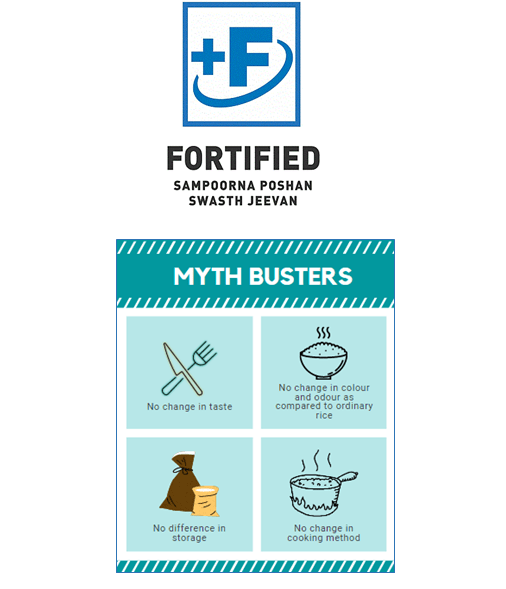
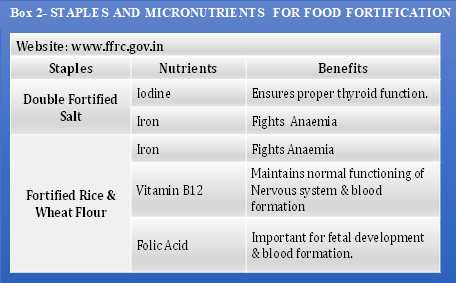
It is a scientifically proven, sustainable and cost-effective solution with no change in habit/dietary practice. Global evidence also showcases a vast success of improving public health by fortifying staples. In India three staples are fortified with iron namely wheat flour, rice and salt. These act as a good vehicle as these are most commonly consumed (refer to box 1 & 2).
Fortification of rice, wheat flour and salt act as a complementary strategy to address the problem of anaemia in the country and is a safe and cost-effective strategy requiring no behavioural change by the consumer.

What work has been done?

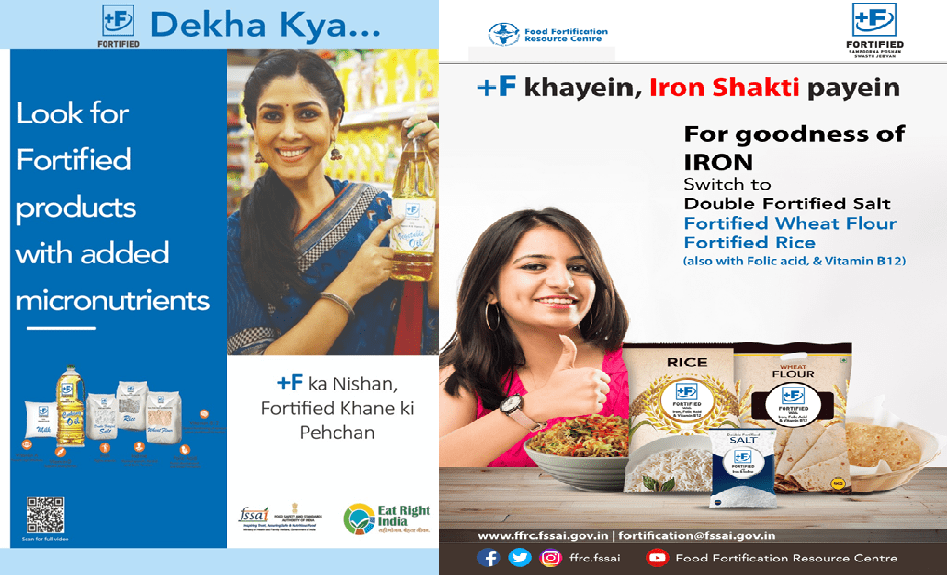
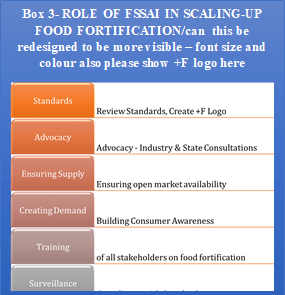
Under the regulatory framework, the Standards for fortification of staples were gazette notified on 2nd August, 2018 by the Food Safety and Standards Authority of India (FSSAI). Currently, wheat flour and rice are fortified with iron, Vitamin B12 and folate with bioavailable plant base sources of nutrients. Double fortified salt has added iodine and iron. The levels of micronutrients have been adjusted to provide 30-50% of Recommended Dietary Allowance (RDA). A dedicated website www.ffrc.fssai@gov.in is functional as a one stop resource provider on food fortification. A unique identification logo +F is developed for easy identification of fortified foods by the consumers and provides assurance that FSSAI standards are being followed for fortification by these products. Currently, fortified staples are available in Integrated Child Development Scheme (ICDS), PM-Poshan Scheme and Public Distribution Scheme (PDS) in some of the States/UTs in India. Recently, on the occasion of 75th Independence, Hon’ble Prime Minister Sh. Narendra Modi announced fortified rice to be distributed under various government schemes by 2024. Central Government has taken an initiative to supply fortified rice throughout the Public Distribution System (PDS), Integrated Child Development Services (ICDS) and PM-POSHAN scheme in all states/UTs to the beneficiaries in a phased manner to address anaemia and micronutrient deficiency in the country.

To create awareness on the importance and use of fortified staples and scale-up rice fortification, FSSAI has conducted various communication campaigns on radio, TV, social media, publications, etc. In collaboration with development partners, FSSAI is conducting a cooking and tasting demonstration of fortified rice at district level across states to build assurance and trust among people. FSSAI is focussing on working towards converging an effective approach to combat dietary iron deficiency anaemia, especially in vulnerable population.  

All Editorials

No Results Found

The page you requested could not be found. Try refining your search, or use the navigation above to locate the post.

Road Safety – Campaign Updates (March 2022)

Road Safety – Campaign Updates (March 2022)

Road Safety – Campaign Updates (March 2022)

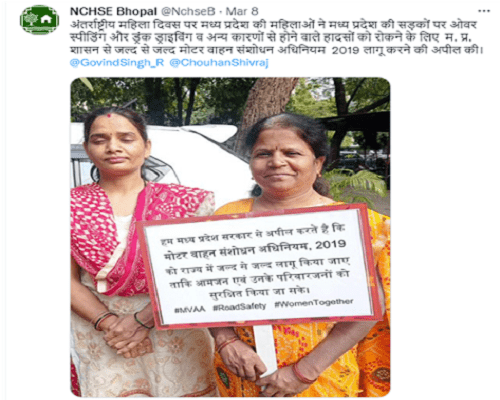
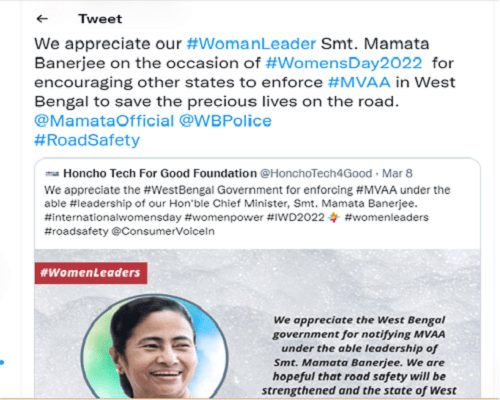
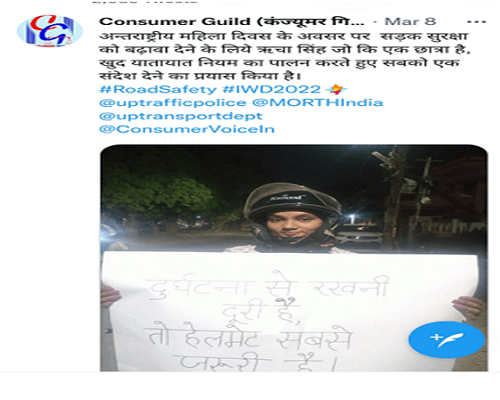
On the occasion of International Women’s Day– 8th March 2022 women from diverse backgrounds came forward to support road safety initiative.

In Madhya Pradesh state women came forward and demanded for speedy notification of Motor Vehicles Amendment Act 2019 to strengthen road safety and reduce road fatalities & injuries.

In West Bengal State several women drivers appealed to the citizens to follow the traffic rules and to fulfill their responsibilities as responsible drivers.
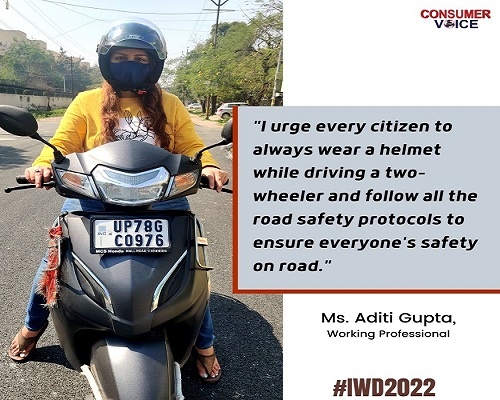
In Uttar Pradesh women drivers focused on risk factors and appealed to citizens to wear helmets, seat belts, slow down etc to strengthen road safety.

Consumer VOICE  used its digital channels and emphasized to strengthen road safety and highlighted appeal by women drivers to drive responsibly and follow traffic rules etc.

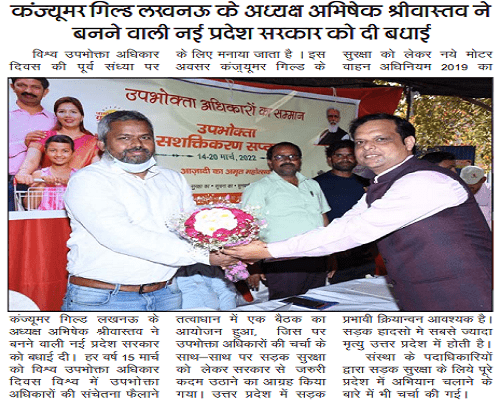
On the occasion of World Consumer Rights Day -15th March 2022 our partner in Uttar Pradesh organized a sensitization programme and circulated press release congratulating new government and an appealed to strengthen the road safety. 

In Madhya Pradesh and West Bengal also consumer activists and organizations came forward and through social media postings urged to make roads safer. 

On the occasion of Holi 18th March 2022, we sensitized people using our digital channels to drive responsibly and focused on risk factors such as drink driving, speed etc.
Enquire Now

    X
    Enquire Now