
13 Reasons Why You Need to File Income Tax in India

13 Reasons Why You Need to File Income Tax in India

13 Reasons Why You Need to File Income Tax in India

Health Insurance

I am a tuition teacher, I don’t need to file income tax. I am just a middle-class woman earning some money from my home kitchen, surely, I don’t need to file income tax. If you can relate to these statements then it’s probably time, we enlighten you on why tax filing is important for everyone, a self-employed person, a freelancer or a white collared employee of an MNC.

To make things easier, we have highlighted 13 reasons why you need to file income tax in India. Read them all here.

  1. To Help the Government

One good reason to file an income tax is to help the government decide the means and amounts of expenditure of citizens. When the government has realistic data, it helps in creating citizen-friendly policies.

  1. It’s Mandatory at Times

Filing returns become mandatory for people who earn a specific amount of money in a year. If it is found that you are not filing the income tax when it’s mandatory for you, you can get in trouble with the income tax department.

  1. Registration of Property Becomes Easier

If you want to register a property in your name, furnishing income tax returns of the past three years might help you to get done with the process easily.

  1. Getting Loans Becomes Simple Too

People who want to take a home loan should maintain a steady record of all income tax returns as a loan provider would certainly want to see the same to establish your credibility as a loan seeker.

  1. Getting a Credit Card is Simpler

If you want a new credit card, providing copies of your income tax returns will help the card provider to issue you a card swiftly.

  1. Claiming Adjustments

Claiming adjustments against past losses is easy when you have filed income tax consistently.

  1. Revised Returns

In case you want to file a revised return, you must have filed the original return previously.

  1. Revoking Rejections

When you have filed income tax returns for years, you can show it as a proof of your reliability to a loan company and persuade it to cancel your loan application rejection. It also comes in handy if the loan provider is offering a less amount than the amount of loan you need.

  1. Visa Processing

If you want to go abroad, you will need to have a visa interview. During the interview, you will be asked to furnish ITR receipts of the last few years or the latest year. It will ensure the country administration of the nation you plan to travel to that you will come back to India and won’t settle there.

  1. Purchasing High Life Cover

In case you want to get a high valued life cover, the ITR receipts will come in handy. This is especially needed when you want to buy a term policy with a sum insured that is of INR 50 lakhs or more.

  1. Government Tenders

If you plan to bid for any government tenders, you will need to provide ITR receipts to prove that you are reliable. The number of receipts you need to provide varies from one government department to the other.

  1. Proof of Income

If you are self-employed or work as a freelancer, an ITR return might work as a substantial proof of income. It comes in handy during job interviews if you plan to join the corporate world again.

  1. Marriage Prospects

Believe it or not, if you are self-employed and you need to prove your earnings to a prospective bride or groom or their families, ITR receipts will help them trust you better, especially if it’s an arranged marriage.

Why Are Co-Operative Banks in India Essential for the Country?

Why Are Co-Operative Banks in India Essential for the Country?

Why Are Co-Operative Banks in India Essential for the Country?

Health Insurance

There are a lot of co-operative banks in India and so long that we are just used to them being there. Have you ever paused and thought why India has so many co-operative banks?  Are they essential for the economy? Are they vital for democracy? If so, you’ll get all the answers right here.

WHAT IS A CO-OPERATIVE BANK?

For the uninitiated, a co-operative bank is a financial entity that belongs to the members. The members of such banks are the customers as well as the owners of the bank. Though these banks need to comply with prudential bank regulations, they usually belong to the people who created them. These people often belong to the same professional or local community.

KEY CHARACTERISTICS OF CO-OPERATIVE BANKS

  • The main goal of such banks is not to earn a profit but to provide quality services to all the members and even the non-members.
  • The Board of Directors are elected by the members who have the same voting right. One person, one vote principle, is followed.
  • Most of the profits are usually used to build reserves, but some of them can be allocated to members as well.
  • In India, co-operative banks have short- and long-term co-operative structure.
  • Key types of co-operative banks in India are Primary Co-operative Credit Society, Central Co-operative Banks, State Co-operative Banks, Land Development Banks, and Urban Co-operative Banks.
  • These banks have to abide by the Co-operative Societies Act of 1904.
  • They also need to follow the rules laid down by the Registrar of Co-operative Societies.

WHY ARE CO-OPERATIVE BANKS IN INDIA ESSENTIAL?

  • Rural Financing

These banks play a key role in rural financing which includes but is not limited to providing finances for agriculture, milk, livestock, personal finances, nursery, etc.

  • Urban Areas’ Development

They promote the development of urban areas by facilitating self-employment, personal finance, home finance, consumer finance.

  • Promotion of Small Industries

They also help in the promotion of industries and small-scale units.

  • Promotion of Democratic Values

These banks promote democratic principles because they are created for the people, by the people and are of the people.

In essence, it can be said that co-operative banks in India are essential because they help in the development and welfare of the people and are not just profit-oriented. These banks reach out to those in need of money in rural areas and hence help in the development of remote areas. Though upgrading these banks and managing them better is the need of the hour, eliminating them won’t be a good idea.

How to Reduce Food Carbon Footprint

How to Reduce Food Carbon Footprint

If you are thinking of ways on how to reduce food carbon footprint, avoiding meat is the first thing that needs to be done as per most research studies. Food carbon footprint or foodprint requires immediate attention as growing, rearing, processing and transporting and disposing of food leaves behind food carbon footprint which is harmful.All food carbon emissions are reported to include major greenhouse gases such as carbon dioxide, methane and nitrous oxide.

Greenhouse gas emissions result from the production and transportation of food. Growing of food requires fertilizers which are mostly chemical based and transportation of food requires use petroleum-based fuel. Given below are some helpful tips on how to reduce food carbon footprint to save the Earth.

TIPS ON HOW TO REDUCE FOOD CARBON FOOTPRINT

When it comes to ways on how to reduce food carbon footprint choosing a vegan diet over meat and eggs is one of he best ways of doing.

  • Consume whole grains, beans, pulses, fruits and vegetables, and avoid excess consumption of eggs, dairy and meat products.
  • Choose the stove top (cooking gas) over other electric cooking appliances for cooking, such as induction and electric oven.
  • Choose the microwave oven over other electric appliances as it uses 50 per cent less energy.
  • Consume organic products. Organic farming methods are much more environment-friendly than other conventional farming methods.
  • Avoid stocking a lot of food products. It is always recommended to discard the food product if it has surpassed its expiry date. Mostly, some of the stocked food items expire before usage and are discarded. Overstocking will reduce food wastage.
  • Avoid consumption of tertiary processed foods (even vegetarian food items). For this you can check the food label – a longer list of ingredients generally suggests that the food item is heavily processed and it may therefore have a high carbon footprint.
  • Avoid consumption of frozen foods. Frozen food has the highest carbon footprint, followed by canned, plastic, glass and then cardboard.
  • Avoid products that use a lot of packaging.
  • Limit the consumption of bottled water. This will limit the usage of plastic and will ultimately help in slowing down global warming.
  • In any case, reduce your personal water consumption by practising water conservation in your daily life.
  • Wherever possible, shop local. Know where your food comes from – if it is from the other side of the world, it will have a high transportation footprint. Also, as the distance the food travels decreases, so does the need for processing and refrigeration to reduce spoilage.

Changing the foods that we eat can have a big impact on the carbon footprint. It can reduce pollution, preserve the environment and slow global warming. Many of these changes will also save money, improve health and even keep us fit besides ofcourse reducing food carbon footprint!

Recommended Dietary Allowance (RDA)

Recommended Dietary Allowance (RDA)

Nutrition is a basic human need and a prerequisite to a healthy life. A proper diet is essential from the very early stages of life for proper growth, development and to remain active. RDA represents the nutrients in terms of diets that should be consumed by the population.

Recommended Dietary Allowance (RDA) is the amount of essential nutrients such as vitamins, minerals etc that has been established by Indian Council of Medical research (ICMR) as adequate to meet the average daily nutritional needs of most healthy persons according to age group and sex.

In India, the concept of RDA dates back to the 1944. The first attempt to define nutrient requirements was made by Nutrition Advisory Committee of the Indian Research Fund Association now known as Indian Council of Medical Research (ICMR) in 1944.  Since then it is revised every 10 years. Current RDA was set in year 2010.

FACTORS ON WHICH RDA DEPENDS:

Recommended Dietary Allowance for individuals would depend upon different factors. These include:

  1. Age of the individual
  2. Physical activity
  3. Sex
  4. Body composition
  5. Vulnerable: pregnant and lactating mothers, infants and elderly people.

ON THE BASIS OF PHYSICAL ACTIVITY, INDIVIDUALS HAVE BEEN CLASSIFIED AS

  1. Sedentary worker – with least physical activity like lawyer, teacher, doctor
  2. Moderate worker – with moderate physical activity like carpenter, tailor, plumber
  3. Heavy worker- with vigorous physical activity like coal miner, steel worker, army man

WHY IS RDA IMPORTANT?

  1. Maintenance of a state of positive health and optimal performance in populations at large by maintaining ideal body weight.
  2. Ensuring adequate nutritional status for pregnant women and lactating mothers.
  3. Improvement of birth weights and promotion of growth of infants, children and adolescents to achieve their full genetic potential.
  4. Achievement of adequacy in all nutrients and prevention of deficiency diseases.
  5. Prevention of chronic diet-related disorders.
  6. Maintenance of the health of the elderly and increasing the life expectancy

With epidemic increase of consumption of ready to eat food or packed snacks that suit the sedentary lifestyle, it is important to know how much energy and fat these little packets contain. Consumer VOICE decodes food labels of popular products and brands. We compare not only the energy and protein levels but the safer and dangerous limits of salt, sugar and fat as per the Traffic Light labeling System.  

Related

Traffic Light Labeling System

Traffic Light Labeling System

Traffic Light Labeling System

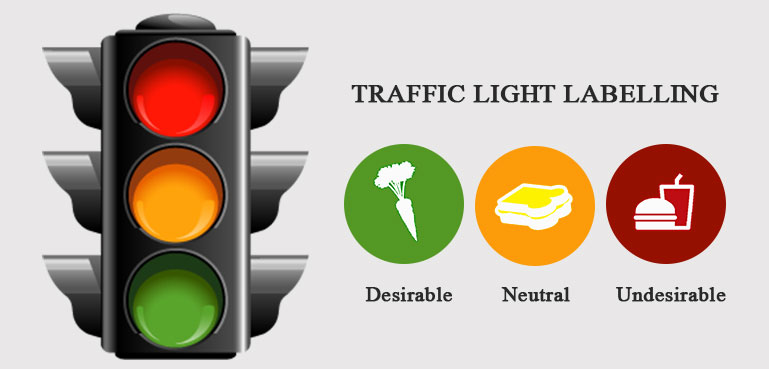
In 2007, Food Standard Agency of UK developed a method of labeling food with a traffic light showing how much fat, sugar and salt are in that food. High Content (unhealthy) is shown by red, Medium (moderate) by amber and Low (healthy) by Green colors. Food with Green color is preferred over the ones with red color.  This is called as Traffic Light Labeling System. The main objective of Traffic Light Labeling guidelines is to

  • Allow consumers to correctly identify healthier food products
  • Assist consumers to make comparison between products easily
  • allow consumers to make these comparisons at a glance.

The label is supposed to be in front of the package and easier to spot.

HOW DOES THE FOOD LABELING SYSTEM WORK

The traffic light labeling system uses three colors:

RED
It indicates that the food is high in fat, sugar or salt. It is best to avoid these kinds of food and can be eaten only rarely.Unhealthy

AMBER
This indicates that content of fat, sugar or salt is medium in these foods and can be eaten occasionally though not on a regular basis.Moderate

GREEN
This colour indicates it is low in fat, sugar or salt and can be eaten or consumed regularly. It is the healthiest of choices.Healthy

For every product the amounts of key nutrients (fat, saturated fats, sugars and salt) are given in grams per 100 grams or 100 millilitres, as a uniform reference value. Consumers interpret this information, with the common traffic light colours of red, amber or green, depending on whether the product contains high, medium or low levels of the respective nutrient.

IS TRAFFIC LIGHT LABELING SYSTEM FOLLOWED IN INDIA?

Traffic Light labeling is not followed in India yet. However, Consumer VOICE is using traffic light rating to help consumers make an informed choice. It is important to let consumers know about the amount of fat and sugar that they are consuming since such foods are linked with obesity and non-communicable diseases like hypertension, and high blood pressure. As part of a pilot project, Consumer VOICE did a study in schools, covering about 10 schools, and Consumer VOICE took the samples of the canteen food and drinks and then it was analyzed for fat, saturated fat, sugar, salt, and converted the results in terms of the traffic lights.

Enquire Now

    X
    Enquire Now