No Results Found
The page you requested could not be found. Try refining your search, or use the navigation above to locate the post.

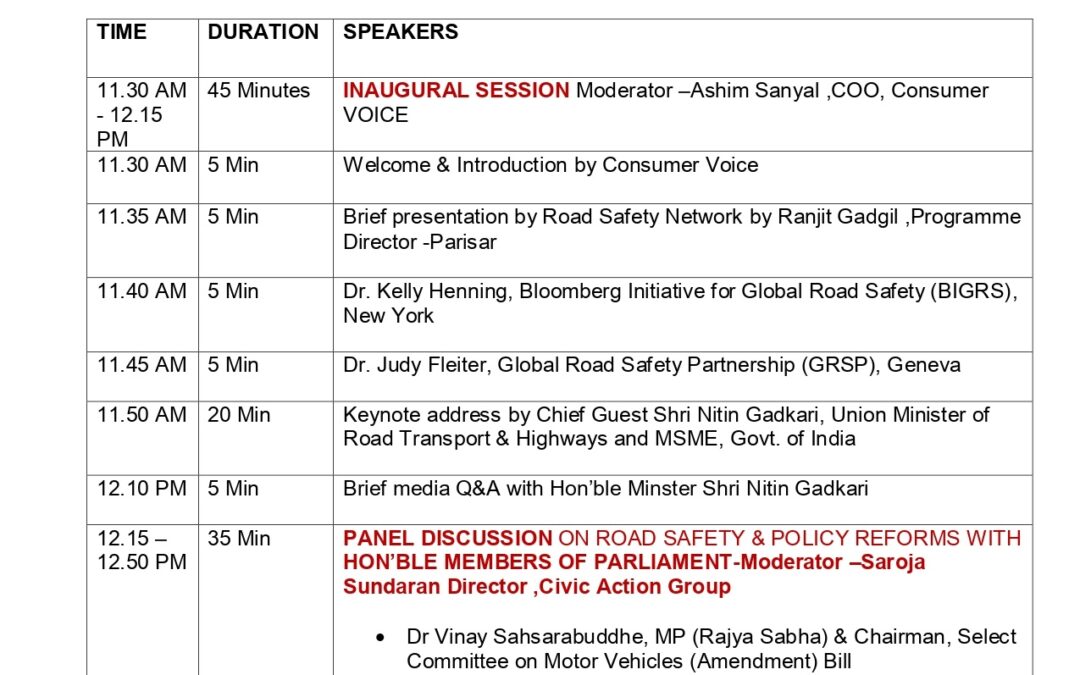
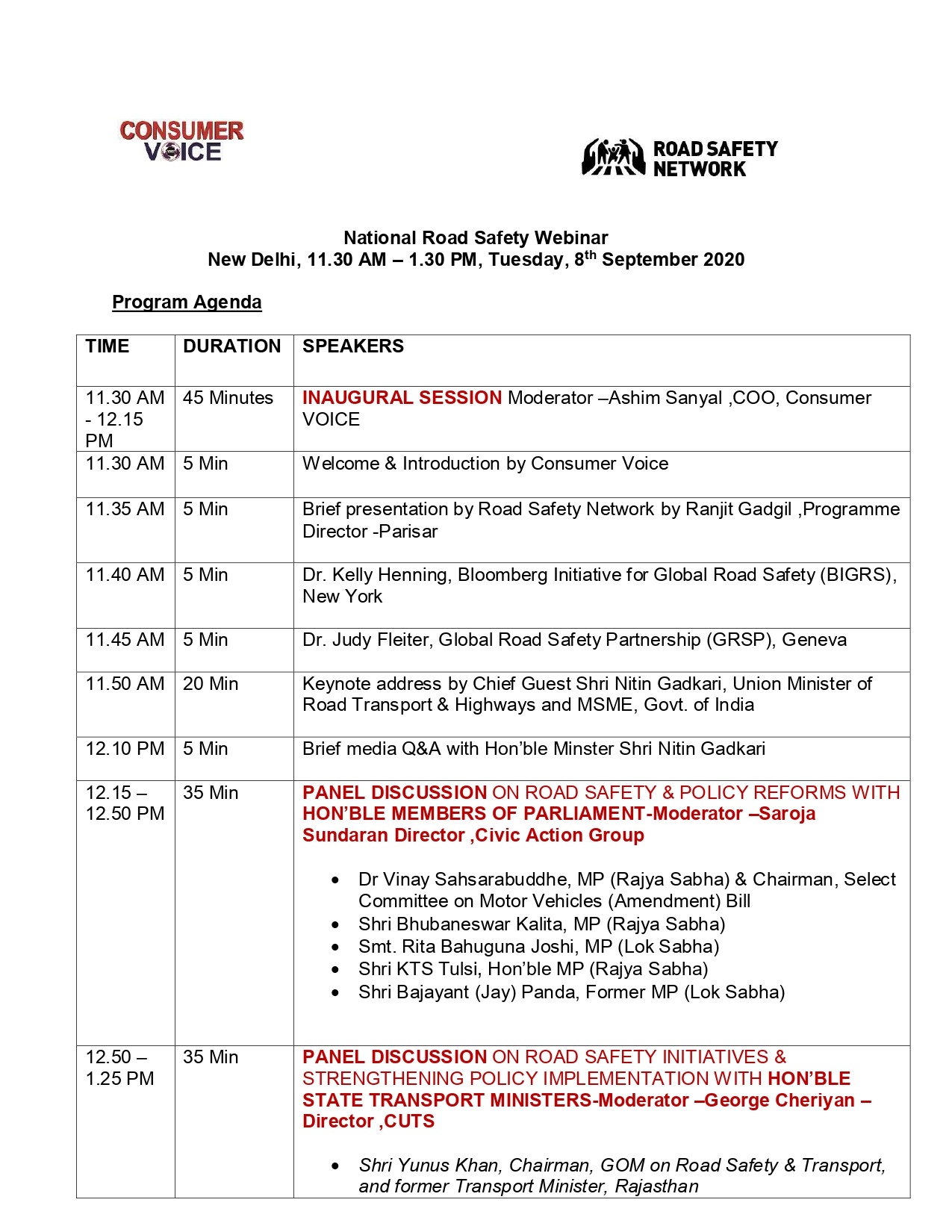
Shri Nitin Gadkari, Hon’ble Minister for Road Transport, Highways, and MSME said road fatalities can be reduced by 50 per cent by 2025 as against the target of 2030 while addressing a webinar organised by Consumer VOICE along with the other partners of the Road Safety Network. In a bid to reduce road accidents the measures that have been outlined by Gadkari included the 4Es- Engineering, Education, Empowerment, and Emergency Care. He asked all educational and research institutions, civil society organisations like Consumer VOICE and state governments to actively participate in generating awareness on road safety and implementing the Motor Vehicle Amendment Act (MVAA).
“My suggestion to all state governments and stakeholders is to create awareness with the help of strong, effective campaigns. I’m ready to do whatever is needed to save lives,” the minister said.
National Road Safety Webinar
He also stressed on the identification of black spots to help reduce road accidents. The government has already appointed a committee in districts under the supervision of a chairman to identify black spots. Most of these black spots are on the National Highways which account for more than 53, 000 accidents every year. This he admits is a national challenge for all stakeholders. The central government, therefore, plans to appoint a private consultant under public-private partnership (PPP) model for an intelligent traffic system, Gadkari added.
“This is the time we should go for PPP (public-private partnership) model in transportation. We will appoint a private consultant, a good reputed company to study how we can make the PPP model in transport system particularly in Intelligent Transport System (ITS) at the state level, municipal corporation level and the National Highways level,” the minister added while addressing the gathering in the webinar.
The webinar also witnessed international participation from Dr. Kelly Henning, Bloomberg Initiative for Global Road Safety (BIGRS), New York and Dr. Judy Fleiter, Global Road Safety Partnership (GRSP), Geneva. While Dr. Kelly Henning congratulated the Indian government on the successful completion of one year of MVAA, Dr. Judy Fleiter appreciated the work down at the ground level by Road Safety Network.
Former MP (Lok Sabha) Shri Jay Panda also appreciated the efforts of the NGOs and the government as he acknowledges the fact that the Act came in after 3 decades of hard campaigning. Road accidents result in a loss of 3% of the GDP and in this pandemic when India is showing a downward hill in the GDP, this is the last thing the country can afford. ‘By cutting down on road accidents, we will add to the GDP as it means there will be less stress on the already overburdened healthcare system due to the pandemic, he added. He also urged the NGOs to be more proactive as steps taken outside the parliament is equally important to the steps taken inside the parliament. Shri Yunus Khan, Chairman, GOM on Road Safety & Transport, and former Transport Minister, Rajasthan said that the accident rate of two-wheelers is quite high in India and therefore there the importance of road safety needs to be highlighted in educational institutes.
Motor Vehicles Amendment Act 2019 completed one year on September 1, 2020. After almost 30 years a major change came in the form of MVAA 2019 in road safety scenario of India. This Act became a reality due to the dedicated efforts of various stakeholders.
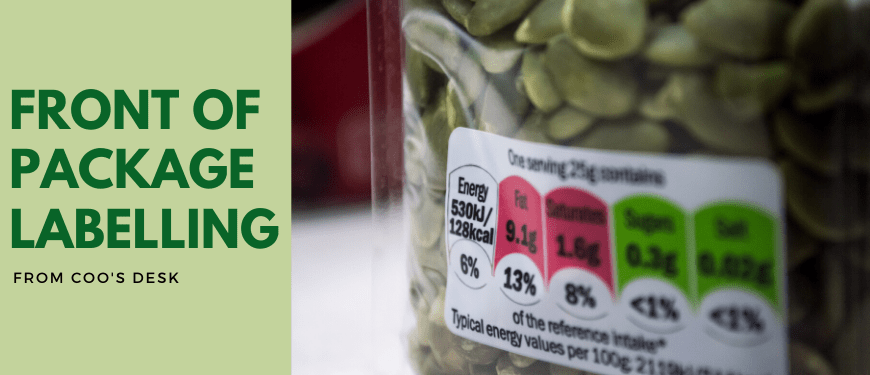
Front-of-package labelling (FOPL) – Healthy choice for consumers

Did you know that poor diet is not limited to insufficient intake of nutrients but also excess intake of salt, sugar and fat which is one of the biggest cause of non-communicable diseases worldwide, with India being no exception. According to the National Diabetes and Diabetic Retinopathy Survey report 2019, Males showed a prevalence of diabetes (12%) as females (11.7%). Cases of Type 2 diabetes is on the rise and every year globally 15 million people die from NCD between the ages of 30 and 69 years. Something serious must be done, before it reaches a pandemic and an important way to control it is availability and accessibility of healthier choices. How can this be done? This can be done through front of package labelling or FOPL.
WHAT IS FRONT-OF-PACKAGE LABELLING (FOPL)
Front-of-package labelling refers to symbols and rating systems, including shelf-tag labels, which are designed to summarize the key nutritional characteristics of food products.
Front-of-package labels have been proposed as an approach to help consumers make healthier food choices at the point of purchase. However, there are concerns about the possible misinterpretation of front-of-package labels. Currently, there is no consensus on the most effective front-of-package format. There is a wide variety of front-of-package labelling systems that are inconsistent, which may add to consumers’ confusion.
Labeling is an effective policy tool when consumer preferences differ as noted in several nutrition labelling studies. Consumers have different concerns about nutrition. The standardized nutrition label provides a large amount of clear, concise nutrition information and allows consumers to make their own choices.
HOW WILL FOP HELP CONSUMERS?
Food label represents the identity card of food products: it reports composition, ingredients and their relative amounts, it informs about quality, origin, processing and preservation. This information gives the consumer the opportunity to consciously choose what to purchase. The label could concretely help us in protecting and improving our health, if our choices are supported by some basic knowledge of wholesome nutrition, based on a balanced and varied diet. In a wider perspective, this may translate into a reduction of obesity and chronic disease incidence – closely related to negative eating habits – and significantly impact on public health in terms of costs for individuals and medical systems.
Public organizations are taking particular care in encouraging the population to adopt healthier lifestyles and to comply with wholesome dietary habits, since diet is one of the earliest modifiable risk factors everyone could personally handle to protect his own health.
In this regard, FSSAI, the country’s apex food regulator, announced the formation of an expert panel to look into the draft Food Safety and Standards (Labelling and Display) Regulations, 2018, which were announced in April 2018.
To date, three main nutritional goals are strongly recommended to reduce the risk of becoming obese and developing diabetes as well as cardio vascular diseases: to reduce salt, saturated and trans fats intakes, while increasing the consumption of fruit and vegetables. We also remind that this needs to be joined to appropriate physical activity.
FUTURE OF FOP LABELING
Food label represents the identity card of food products: it reports composition, ingredients and their relative amounts, it informs about quality, origin, processing and preservation. This information gives the consumer the opportunity to consciously choose what to purchase. The label could concretely help us in protecting and improving our health, if our choices are supported by some basic knowledge of wholesome nutrition, based on a balanced and varied diet. In a wider perspective, this may translate into a reduction of obesity and chronic disease incidence – closely related to negative eating habits – and significantly impact on public health in terms of costs for individuals and medical systems.
Public organizations are taking particular care in encouraging the population to adopt healthier lifestyles and to comply with wholesome dietary habits, since diet is one of the earliest modifiable risk factors everyone could personally handle to protect his own health.
In this regard, FSSAI, the country’s apex food regulator, announced the formation of an expert panel to look into the draft Food Safety and Standards (Labelling and Display) Regulations, 2018, which were announced in April 2018.
To date, three main nutritional goals are strongly recommended to reduce the risk of becoming obese and developing diabetes as well as cardio vascular diseases: to reduce salt, saturated and trans fats intakes, while increasing the consumption of fruit and vegetables. We also remind that this needs to be joined to appropriate physical activity.
For other articles by Consumer VOICE COO’s Desk, click here
You may also read
The page you requested could not be found. Try refining your search, or use the navigation above to locate the post.
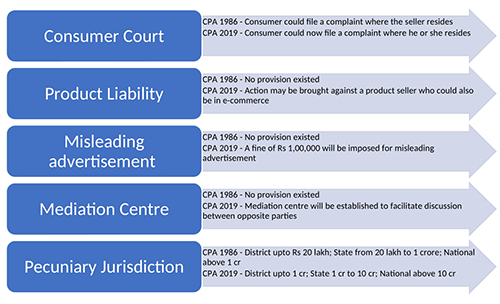
5 Positive Key Features in Consumer Protection Act, 2019
The old Consumer Protection Act of 1986 has been repealed and replaced lock stock and barrel with the new law passed by the Parliament in 2019. The new law has come into effect from 20th July, 2020 ushering in many new changes. The five positive changes that have replaced the three-decade old Consumer Protection Act 1986 are:
There have been numerous instances in the past where consumers have been victims of unfair trade practices. This Act addresses the menace of adulteration, by making manufacture, sale, storage of products mixed with adulterants punishable offences. The Act also states punishment for manufacturing for sale or for storing or selling or distributing or importing of spurious goods. A consumer may be imposed with a fine of up to INR 1,000,000 (One million rupees) on a manufacturer or an endorser, for a false or misleading advertisement and imprisonment for up to two years for a false or misleading advertisement
The new Act introduced the key concept of ‘product liability’, wherein action may be brought in against a product manufacturer, product service provider or product seller for any harm caused to the complainant on account of a defective product. It includes the seller who places an item for commercial purposes on the e-commerce platform as well.
For nearly 147 years Indian courts have upheld the validity of all terms of contracts if the contract was validly entered and have refused to judge the reasonableness of terms of contracts once parties have bound themselves to such contracts. However, the new Act classifies six contract terms as ‘unfair’. These cover terms such as
A big relief that this Act gives is the widening of jurisdiction of consumer courts. So, if your residential place is outside your cause of action, you can still file the case in your native place. The new Act raises the jurisdiction of District Consumer Court from existing Rs. twenty lacs to Rs. one crore, while State Commissions enhanced from can go beyond Rs 1 crore and the National Commission to over Rs 10 crores.
The idea behind setting up of Mediation Centres is that willing parties in a dispute should discuss the dispute with an empanelled Mediator to find a mutually acceptable solution. Mediation Centers would be set up at the Central, State and District levels prescribed by respective state and central governments.
So, with the advent of this new Act, consumers are now the king!
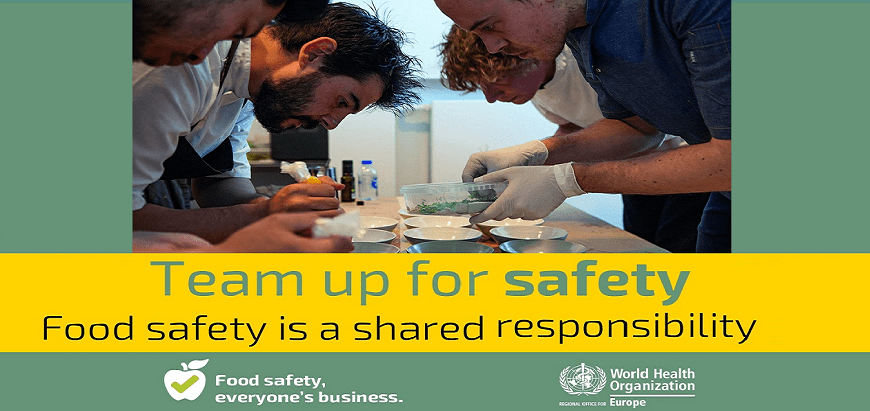
The second World Food Safety Day (WFSD) will be celebrated on 7th June, 2020 to draw attention and inspire action to help prevent, detect and manage foodborne risks, contributing to food security, human health, economic prosperity, agriculture, market access, tourism and sustainable development.
Food safety is a shared responsibility between governments, producers and consumers. Everybody has a role to play from farm to table to ensure the food we consume is safe and will not cause damages to our health.
Role of trans fat and food safety
On this World Food Safety Day, we must remember that it is not only important to eat hygienic food but it is also important eat nutritious food like trans fat free food. Trans fats, which are unsaturated fatty acids, are industrially produced fats which is partially hydrogenated oil. Because of its chemical properties it is difficult for us to metabolize and therefore unsafe. WHO figures show that trans fat accounts for over half a million death every year globally and in India it is responsible for the death of over 75000 death annually which is highest in the world. Trans fat consumption also leads to increase in low density lipoprotein (LDL) or bad cholesterol and decrease in high density lipoprotein (HDL) or good cholesterol levels in our body which is turn is responsible for non-communicable diseases (NCDs).