No Results Found
The page you requested could not be found. Try refining your search, or use the navigation above to locate the post.


Exploring the wide array of consumer choices reveals both positive and negative trends that significantly impact the market, the environment, and society. On the positive side, there is an encouraging shift towards informed consumerism, with individuals prioritizing transparency and ethical business practices. It is awesome to see this vibe extending to sustainability, with more consumers choosing eco-friendly products and pushing companies to be more responsible. Additionally, there is a commendable resurgence in support for local businesses, indicating that people are realizing the importance of helping their communities grow economically.
But, you know, it’s not all rainbows and sunshine. Challenges arise from impulsive buying and overconsumption, contributing to a throwaway culture. Fast fashion, single-use plastics, and excessive packaging reflect a trend that prioritizes instant gratification without thinking about the long-term impact on the planet and our society. Also, blind loyalty to brands can also be detrimental when it fosters allegiance without critical evaluation, potentially perpetuating unethical practices and maybe supporting some not-so-great products. Further, disregard for product lifecycle leads to improper disposal of items, and eventually becomes one of the causes of environmental degradation.
Finding a balance between satisfying your own desires and acting as a responsible steward of the planet and society is important. Making informed choices, ethical consumption, and a commitment to sustainability can collectively shape a consumer landscape that not only fulfils immediate needs but also helps in making the world a better, happier place.
As we take a moment to think about our consumer choices, especially with our 75th Republic Day celebration, it’s a great time to appreciate the values that make our nation so diverse and lively. The positive trends of informed consumerism, sustainability, and support for local businesses align with the principles of unity in diversity and responsible citizenship that our Republic stands for. By making choices that are ethical, good for the planet and embracing sustainability, we contribute not only to our individual well-being but also to the collective prosperity of our nation.
Let us remember that our choices are not just about what we buy – they are woven into the bigger picture of our society. As responsible consumers, let us uphold the ideals of justice, liberty, equality, and fraternity that form the cornerstone of our Republic. May our united actions reflect the values that make our nation resilient, inclusive, and forward-looking.
We extend heartfelt gratitude to our esteemed readers for their unwavering support. Your engagement, feedback, and ideas continue to play a pivotal role in our mission to deliver informative articles. We invite you to share your thoughts and suggestions at info@consumer-voice.org, as together, we foster a knowledgeable and empowered community.
Wishing you an enriching and enjoyable reading experience ahead!
Pallabi Boruah
Editor
The page you requested could not be found. Try refining your search, or use the navigation above to locate the post.

As the prevalence of diabetes continues to rise steadily in India, individuals grappling with this chronic condition encounter myriad challenges, particularly in obtaining comprehensive health insurance coverage. The constant management and specialized care required for diabetes underscore the necessity for individuals with this condition to secure adequate insurance coverage. This article provides an in-depth exploration of the insurance landscape for diabetics in India, delving into existing challenges, examining the current scenario, and proposing potential solutions to bridge the existing gaps.
Subas Tiwari
Understanding the Diabetes Epidemic in India
Diabetes has emerged as a significant public health concern in India, witnessing a concerning surge in cases over the past few decades. According to the International Diabetes Federation (IDF), India is home to over 77 million adults with diabetes, a number expected to escalate in the coming years. Given the economic and health implications of diabetes, there is a critical need for a comprehensive approach, including robust insurance coverage.
The Current State of Insurance Coverage for Diabetics
While health insurance is pivotal for managing healthcare costs in India, individuals with pre-existing conditions such as diabetes often encounter hurdles in obtaining comprehensive coverage. Diabetes is typically classified as a pre-existing condition by insurance companies, resulting in higher premiums and exclusion of certain benefits.
Challenges Faced by Diabetics in Obtaining Insurance:
Initiatives and Solutions
Recognizing the challenges faced by diabetics, both the government and private insurance providers are taking steps to enhance access to comprehensive coverage. Key initiatives and potential solutions include:
Despite existing challenges, there is a growing recognition of the need for comprehensive insurance coverage for individuals with diabetes in India. The collaborative efforts of both public and private stakeholders reflect a concerted attempt to bridge the gap and ensure diabetics have access to the financial protection they require. As India contends with the diabetes epidemic, addressing insurance challenges for individuals with the condition is crucial for building a healthier and more resilient society.
Best Health Insurance Plans for Diabetics in India
For diabetes-related treatments, individuals can opt for health insurance policies designed specifically for diabetes. Indian health insurers offer exclusive plans such as Star Health Diabetes Safe, ICICI Prudential Diabetes Care, and National Insurance Varishta Mediclaim, among others.
According to an IDF report, India is projected to witness a substantial increase in diabetes cases, with an estimated 93 million cases by 2030 and 125 million cases by 2045. Consequently, having health insurance for diabetes is crucial, providing tailored financial support for comprehensive coverage against complications or diseases related to this condition. Therefore, investing in such insurance is of utmost importance.
In India, diabetes insurance typically covers regular hospitalization expenses for both diabetic and non-diabetic complications. Regular health insurance plans often exclude coverage for pre-existing conditions and may impose waiting periods before providing coverage. However, specialized diabetes insurance plans are specifically designed to address high blood sugar levels and related illnesses.
These custom-tailored plans typically offer coverage for both Type 1 and Type 2 diabetes, with options for Individual or Family Floater plans based on individual needs. In addition to hospitalization coverage, health insurance for diabetes may extend to outpatient expenses, such as medical consultations and diagnostic tests. Some plans also include a Personal Accident cover, providing payment in the event of accidental death of the insured individual.
This Insurance Companies are offering Diabetes Health Insurance Plans
Diabetes health insurance is specialized medical coverage designed to address expenses related to diabetes treatment and hospitalization. This type of insurance plan caters to high blood sugar levels resulting from inadequate insulin secretion in the body, leading to severe complications like renal failure, vision loss, and heart stroke.
What is covered?
Diabetes health insurance plans typically provide coverage for various aspects, including:
What is not covered?
Exclusions typically found in diabetes insurance plans include:
How to Buy Diabetes Health Insurance Policy?
To purchase diabetes health insurance, follow these steps:
Benefits of Diabetes Health Insurance
Advantages of health insurance for individuals with diabetes in India include coverage for:
Navigating the complex landscape of health insurance for diabetes in India requires careful consideration and informed decision-making. To assist individuals in this process, here are 20 essential tips for buying a Diabetes Health Insurance Plan:
Remember, investing time and effort into understanding and choosing the right Diabetes Health Insurance Plan is crucial for long-term financial security and effective diabetes management. Always read the policy documents carefully, and don’t hesitate to ask questions to clarify any doubts before making a decision.
Related
The page you requested could not be found. Try refining your search, or use the navigation above to locate the post.

Consumers are finding themselves in a wide online landscape in an era of digital convenience. Although there are many advantages of the internet, it is important to stay vigilant against such practices commonly referred to as dark patterns. These subtle design choices alter consumer behaviour, often leading to unintended effects.
Rinki Sharma
The Ministry of Consumer Affairs, Food and Public Distribution has released directives addressing the prevention and oversight of dark patterns. These guidelines target deceptive design practices that manipulate users, compromising their autonomy and decision-making. Applicable to all platforms offering goods or services in India, along with advertisers and sellers, the regulations fall under the jurisdiction of the Central Consumer Protection Authority (CCPA), established by the Consumer Protection Act, 2019.
The guidelines explicitly forbid any individual or platform from employing dark patterns. They enumerate prohibited practices, such as false urgency, basket sneaking, and forced actions. Non-compliance with these guidelines may result in penalties. These measures are designed to safeguard consumer rights and ensure fair and transparent interactions in the marketplace.
Understanding Dark Patterns: These are user interface design tricks that can be used to direct users in taking actions that they possibly would not have taken willingly.
Do’s:
Don’ts:
By staying informed and making wise choices, individuals can empower themselves against online manipulation. Practicing caution and following best practices can equip consumers with the confidence and security needed to navigate the digital landscape. Your Online Safety Matters!
The page you requested could not be found. Try refining your search, or use the navigation above to locate the post.

Answer: Yes Can file complaint together by number of consumers as ‘class action’ or ‘joint complaint’
Sec 2(v) ‘complainant’ one or more consumers, where there are numerous consumers having the same interest
(c) one or more consumers, where there are numerous consumers having the same interest, with the permission of the District Commission, on behalf of, or for the benefit of, all consumers so interested;
Sec 18 (1) (a)
Central Consumer Protection Authority (“Central Authority“) under Section 18 (1) (a) to “protect, promote and enforce the rights of consumers as a class”
Facts. Noting by court on 26.12.2023 as hereunder:
(बिहार पटना)
उभय पक्ष उपस्थित .अभिलेख के आकलन से ज्ञात होता है की विपक्षी द्वारा हर बार समय मांग किया जा रहा है जबकि वादी प्रत्येक तिथि पैर उपस्थित रहते है और उनके द्वारा लिखित बेहेस भी दाखिल किया जा चूका है.ऐसी स्थिति में विपक्षी जब तक ६००/-रूपया कास्ट की राशी जमा नहीं करत तब तक उसकी बहस स्वीकार नहीं की जाएगी अगली तिथि 2.2.2024
नोटिंग 2.2.2024
अगली तिथि 13.5.2024.
Answer:
Write to Ministry of consumer affairs Govt of India, State Consumer commission and Nation consumer commission with the notings made for adjournments
Court should have heard complainant’s arguments proceeding OP ex party and reserve the order, cost could be added with the order.
Answer: There is no provision of second appeal under the Act
Section 21(b) in the Consumer Protection Act, 1986
(b) to call for the records and pass appropriate orders in any consumer dispute which is pending before or has been decided by any State Commission where it appears to the National Commission that such State Commission has exercised a jurisdiction not vested in it by law, or has failed to exercise a jurisdiction so vested, or has acted in the exercise of its jurisdiction illegally or with material irregularity.
It is pertinent to mention that the same provision exists now in the new Act Consumer protection act 2019 too
58 (1) (b) in Consumer Protection Act 2019
“To call for the records and pass appropriate orders in any consumer dispute which is pending before or has been decided by any State Commission where it appears to the National Commission that such State Commission has exercised a jurisdiction not vested in it by law, or has failed to exercise a jurisdiction so vested, or has acted in the exercise of its jurisdiction illegally or with material irregularity”.
Case Law: Sunil Kumar Maity V/s State Bank of India and Anr. .civil appeal 432 of 2022 decided on 21th Jan 2022
“It is needless to say that the revisional jurisdiction of the National Commission under Section 21(b) of the said Act is extremely limited. It should be exercised only in case as contemplated within the parameters specified in the said provision, namely when it appears to the National Commission that the State Commission had exercised a jurisdiction not vested in it by law, or had failed to exercise jurisdiction so vested, or had acted in the exercise of its jurisdiction illegally or with material irregularity.’
Answer: When the entire building, including the unsold 35 flats, is transferred to the society, these unsold flats now belong to the society as the owner. While the builder may not retain ownership of these flats, it’s plausible that adjustments in accounts have been made, considering the construction and unsold flat costs.
Under these circumstances, occupants are not obligated to pay monthly maintenance charges for the unsold flats. The expenses for common areas, electricity, plumbing, and other communal services are to be covered from the collective funds belonging to the society.
Answer: The complainant has the authority to designate someone to appear on their behalf. Failure of the complainant to appear may lead to the dismissal of the complaint by default.
Answer:
Two issues involved –a) Notice not served.
Answer: If there is no existing order against the manufacturer, the recourse under the product liability clause, specifically Section 85 and 86, allows you to pursue action against the dealer exclusively.
Answer: The property is no longer legally yours as it has been declared government land. You have the option to file a case in a civil court, treating it as a recovery suit, seeking a refund of your money along with compensation for unfair dealing. Alternatively, you can file a complaint before the consumer court or RERA, citing unfair trade practices, and seek a refund along with compensation.
Answer: NCLT is not an appellate court for consumer matters. Therefore, filing an appeal there may not be effective. However, if the case is dismissed due to the opposing party being declared insolvent, you can then act as a financial creditor and submit a claim before NCLT seeking a refund or any other resolution as per the decisions made by NLCT.
Answer: Submit a complaint to the consumer commission and request an interim order for possession at the initially agreed cost until a decision is reached on the merits of the case. File a claim for compensation for the delay in court. Challenge the issue of increased costs by emphasizing that the delay was caused by the builder, and the homebuyer had initially agreed to the cost set during the three-year construction period.
Answer: You can lodge a complaint with the consumer commission, and depending on the merits of the case, you have various options such as repair, replacement, refund, etc.
Answer:
Answer: Submit an application to the electricity department requesting a meter inspection and be prepared to pay a fee for this service. If the meter is discovered to be fast or defective, the billing will be adjusted based on the previous billing pattern, calculating the average over the last six months.
Answer: A replacement is not warranted unless it is declared irreparable or found to have a manufacturing defect. In such instances, one may consider approaching the consumer court, seek an expert opinion, and pursue a decision based on the merits of the case.
Antimicrobial resistance (AMR) is the 21st-century global public health problem. AMR occurs when microbes, such as bacteria, viruses, fungi and parasites stop responding to antimicrobial medicines. Because of the high rate of antibiotic overuse that leads to alterations in the bacterium itself, bacterial AMR poses the greatest concern. AMR is predicted to cause 10 million deaths annually by 2050, according to The Review on Antimicrobial Resistance, a UK government program [1]. WHO and other organizations acknowledge that a promptly coordinated worldwide strategy is necessary to fight AMR, even though they do not agree with this estimate. For this reason, statistics about the present global burden of bacterial AMR and its regional patterns are needed. Future generations will see the emergence of increasingly deadly infections that are incurable if effective management is not implemented. This article sheds light on global trends and developments pertaining to antimicrobial resistance in bacteria.
Dr Vikrant Kumar
All India Institute of Medical Sciences, New Delhi
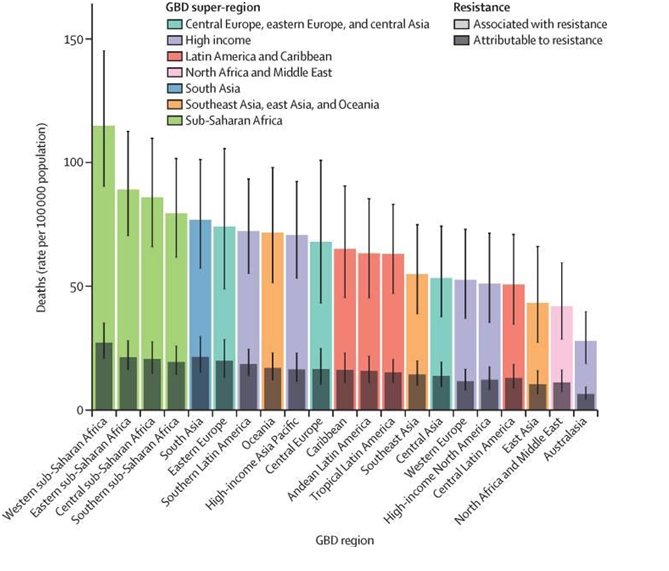
A research that was published in The Lancet estimates that 4.9 million deaths worldwide in 2019 were related to bacterial AMR [2]. It further states that the worldwide burden of bacterial AMR was caused by three infectious syndromes: bloodstream infections, intra-abdominal infections, and lower respiratory and thoracic infections. Six pathogens (E coli, Staphylococcus aureus, K pneumoniae, S pneumoniae, Acinetobacter baumannii, and Pseudomonas aeruginosa) were responsible for majority of the deaths linked to AMR.
Image caption: Mortality rate due to bacterial resistance to antibiotics in 2019. Source: Antimicrobial Resistance Collaborators. Global burden of bacterial antimicrobial resistance in 2019: a systematic analysis [2]
India has one of the highest incidences of AMR worldwide and is an emerging hub for bacterial AMR. AMR’s burden in India is mostly caused by over-the-counter availability of drugs, unrestricted and excessive human use, antibiotic use in poultry and agriculture, public ignorance, and shortcomings in national surveillance and monitoring of AMR. Antimicrobial resistance in India is further exacerbated by inadequate use of diagnostics, overcrowding that increases the risk of cross-infections, over prescription by physicians, and inadequate health infrastructure. The Indian Council of Medical Research (ICMR) annual report on the antimicrobial resistance research and surveillance network (2022) stated that E. coli, which causes meningitis, pneumonia, bacteremia, abdominal and pelvic infections, urinary tract infections, and infections, has become less susceptible to major antibiotics [3]. According to the data, E. Coli resistance to piperacillin-tazobactam climbed from 35% to 56% between 2017 and 2022, while resistance to ceftazidime increased from 18% to 23% and resistance to ciprofloxacin from 12% to 19%. S. aureus has also shown a noticeable upward trend in antibiotic resistance over time against clindamycin and cefoxitin. Similar trends were reported for Klebsiella pneumoniae, a causative agent of pneumonia, bloodstream infections, and meningitis. K. pneumoniae’s sensitivity to imipenem decreased gradually during the previous six years, falling from 59% in 2017 to 42% in 2022. There has been a modest and inconsistent drop in meropenem susceptibility for K. pneumoniae. Nearly, 88% of the Acinetobacter baumannii isolates were resistant to carbapenems and left with limited treatment options. Against A. baumannii, piperacillin/tazobactam, cefepime, ceftazidime, amikacin and levofloxacin showed limited activity. When it comes to hospital-acquired infections, Pseudomonas aeruginosa infections are becoming a major concern, especially in patients who are very sick or have compromised immune systems. P. aeruginosa cause post-surgery infections in the blood, lungs (pneumonia), and/ or other body parts. These bacteria persistently find a new way to evade the effects of the antibiotics and become resistant to the treatment. The growth of drug-resistant bacteria is the main reason for the higher mortality rates. During 2017 to 2022, an increasing resistance was observed in P. aeruginosa against the majority of antibiotics- ceftazidime (41.2% to 43.6%), cefepime (46.1% to 48.1%), imipenem (40.5% to 51.1% ), meropenem (47.9% to 54.1% &), amikacin (51.4% & 60.4%), gentamicin (44.4% to 48.2%), tobramycin (50.1% to 65.8%), ciprofloxacin (35.9% to 38.5%) and levofloxacin (33.3% to 42.6%).
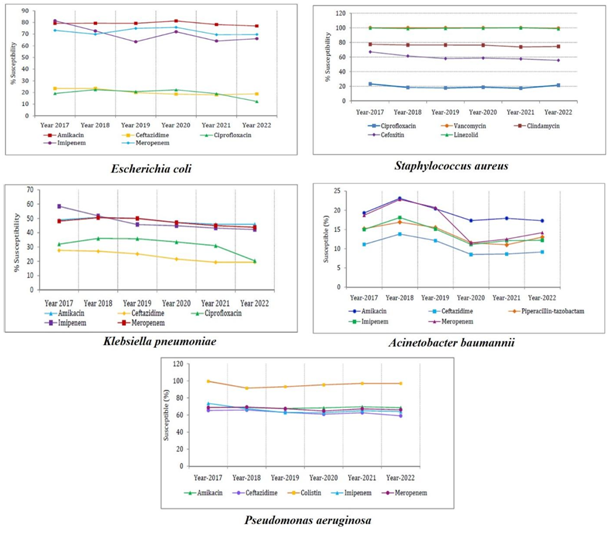
Image Caption: Trends of antibiotic resistance among major bacterial strains from 2017-2022. Source: Annual report on antimicrobial resistance research and surveillance network (2022), ICMR [3]
The use of antibiotics is a cornerstone of modern medicine. The emergence and spread of bacteria resistant to drugs threatens our ability to treat common illnesses and perform life-saving procedures. Antibiotic resistance is a major global health issue that decreases the efficacy of traditional treatments against common bacterial infections. The abuse and overuse of antibiotics in humans, animals, and plants are the main factors contributing to the formation of drug-resistant diseases. AMR affects all important sects a country leading to social and economic burden. Its primary causes are poverty and inequality, with low- and middle-income countries being most affected. The present AMR crisis highlights the urgent need for improved antimicrobial practices and broader surveillance coverage on a worldwide scale. In addition, awareness programs by local governments can help in reducing the cases of antibiotic abuse.
The page you requested could not be found. Try refining your search, or use the navigation above to locate the post.